




Height rank
30 St Mary Axe
London


philoldfield.jpg)
stevenhenry.jpg)
ctbuh-toby__phillips.jpg)

stevenhenry.jpg)
stevenhenry.jpg)
stevenhenry.jpg)
ctbuh-toby__phillips.jpg)
ctbuh-toby__phillips.jpg)
ctbuh-toby__phillips.jpg)


philoldfield.jpg)

ctbuh-toby__phillips.jpg)
ctbuh-toby__phillips.jpg)
stevenhenry.jpg)
- CVU Drawing
- Facts
-
Metrics
You must be a CVU Member to view this resource.
To Tip:
Height is measured from the level of the lowest, significant, open-air, pedestrian entrance to the highest point of the building, irrespective of material or function of the highest element (i.e., including antennae, flagpoles, signage and other functional-technical equipment).Architectural:
Height is measured from the level of the lowest, significant, open-air, pedestrian entrance to the architectural top of the building, including spires, but not including antennae, signage, flag poles or other functional-technical equipment. This measurement is the most widely utilized and is employed to define the Council on Vertical Urbanism (CVU) rankings of the "World's Tallest Buildings."Occupied:
Height is measured from the level of the lowest, significant, open-air, pedestrian entrance to the highest occupied floor within the building.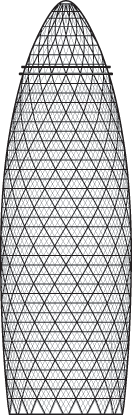
Above Ground
The number of floors above ground should include the ground floor level and be the number of main floors above ground, including any significant mezzanine floors and major mechanical plant floors. Mechanical mezzanines should not be included if they have a significantly smaller floor area than the major floors below. Similarly, mechanical penthouses or plant rooms protruding above the general roof area should not be counted. Note: CVU floor counts may differ from published accounts, as it is common in some regions of the world for certain floor levels not to be included (e.g., the level 4, 14, 24, etc. in Hong Kong).Below Ground
The number of floors below ground should include all major floors located below the ground floor level.Official Name
30 St Mary Axe
Other Names
The Gherkin, Swiss Re Tower
Type
Building
Status
Completed
Completion
2004
Country
City
Address
Function
A mixed-use tall building contains two or more functions (or uses), where each of the functions occupy a significant proportion of the tower's total space. Support areas such as car parks and mechanical plant space do not constitute mixed-use functions. Functions are denoted on CVU "Tallest Building" lists in descending order, e.g., "hotel/office" indicates hotel function above office function.
Office
Structural Material
Both the main vertical/lateral structural elements and the floor spanning systems are constructed from steel. Note that a building of steel construction with a floor system of concrete planks or concrete slab on top of steel beams is still considered an “all-steel” structure as the concrete elements are not acting as the primary structure.
All-Concrete
Both the main vertical/lateral structural elements and the floor spanning systems are constructed from concrete which has been cast in place and utilizes steel reinforcement bars and/or steel reinforced concrete which has been precast as individual components and assembled together on-site.
All-Timber
Both the main vertical/lateral structural elements and the floor spanning systems are constructed from timber. An all-timber structure may include the use of localized non-timber connections between timber elements. Note that a building of timber construction with a floor system of concrete planks or concrete slab on top of timber beams is still considered an “all-timber” structure as the concrete elements are not acting as the primary structure.
Mixed-Structure
Utilizes distinct systems (e.g. all-steel, all-concrete, all-timber), one on top of the other. For example, a Steel Over Concrete indicates an all-steel structural system located on top of an all-concrete structural system, with the opposite true of Concrete Over Steel.
Composite
A combination of materials (e.g. steel, concrete, timber) are used together in the main structural elements. Examples include buildings which utilize: steel columns with a floor system of reinforced concrete beams; a steel frame system with a concrete core; concrete-encased steel columns; concrete-filled steel tubes; etc. Where known, the CVU database breaks out the materials used within a composite building’s primary structural elements.
All-Steel
Official Website
Height
179.8 m / 590 ft
Floors Above Ground
40
Floors Below Ground
1
# of Parking Spaces
272
# of Elevators
24
Top Elevator Speed
6 m/s
Tower GFA
64,470 m² / 693,949 ft²
Rankings
-
By function
You must be a CVU Member to view this resource.
-
By material
You must be a CVU Member to view this resource.
Construction Schedule
Proposed
Construction Start
Completed
Architect
Usually involved in the front end design, with a "typical" condition being that of a leadership role through either Schematic Design or Design Development, and then a monitoring role through the CD and CA phases.
Structural Engineer
The Design Engineer is usually involved in the front end design, typically taking the leadership role in the Schematic Design and Design Development, and then a monitoring role through the CD and CA phases.
The Peer Review Engineer traditionally comments on the information produced by another party, and to render second opinions, but not to initiate what the design looks like from the start.
MEP Engineer
The Design Engineer is usually involved in the front end design, typically taking the leadership role in the Schematic Design and Design Development, and then a monitoring role through the CD and CA phases.
Contractor
The main contractor is the supervisory contractor of all construction work on a project, management of sub-contractors and vendors, etc. May be referred to as "Construction Manager," however, for consistency CTBUH uses the term "Main Contractor" exclusively.
Other Consultant
Other Consultant refers to other organizations which provided significant consultation services for a building project (e.g. wind consultants, environmental consultants, fire and life safety consultants, etc).
Other Consultant refers to other organizations which provided significant consultation services for a building project (e.g. wind consultants, environmental consultants, fire and life safety consultants, etc).
Material Supplier
Material Supplier refers to organizations which supplied significant systems/materials for a building project (e.g. elevator suppliers, facade suppliers, etc).
Material Supplier refers to organizations which supplied significant systems/materials for a building project (e.g. elevator suppliers, facade suppliers, etc).
You must be a CVU Member to view this resource.
Owner
Bury Street Properties
IVG; Evans Randall; Swiss Re
Developer
Swiss Re
Architect
Usually involved in the front end design, with a "typical" condition being that of a leadership role through either Schematic Design or Design Development, and then a monitoring role through the CD and CA phases.
Structural Engineer
The Design Engineer is usually involved in the front end design, typically taking the leadership role in the Schematic Design and Design Development, and then a monitoring role through the CD and CA phases.
The Peer Review Engineer traditionally comments on the information produced by another party, and to render second opinions, but not to initiate what the design looks like from the start.
MEP Engineer
The Design Engineer is usually involved in the front end design, typically taking the leadership role in the Schematic Design and Design Development, and then a monitoring role through the CD and CA phases.
Project Manager
The CTBUH lists a project manager when a specific firm has been commissioned to oversee this aspect of a tall building’s design/construction. When the project management efforts are handled by the developer, main contract, or architect, this field will be omitted.
The CTBUH lists a project manager when a specific firm has been commissioned to oversee this aspect of a tall building’s design/construction. When the project management efforts are handled by the developer, main contract, or architect, this field will be omitted.
RWG Associates
Contractor
The main contractor is the supervisory contractor of all construction work on a project, management of sub-contractors and vendors, etc. May be referred to as "Construction Manager," however, for consistency CTBUH uses the term "Main Contractor" exclusively.
Other Consultant
Other Consultant refers to other organizations which provided significant consultation services for a building project (e.g. wind consultants, environmental consultants, fire and life safety consultants, etc).
Other Consultant refers to other organizations which provided significant consultation services for a building project (e.g. wind consultants, environmental consultants, fire and life safety consultants, etc).
Wordsearch
Material Supplier
Material Supplier refers to organizations which supplied significant systems/materials for a building project (e.g. elevator suppliers, facade suppliers, etc).
Material Supplier refers to organizations which supplied significant systems/materials for a building project (e.g. elevator suppliers, facade suppliers, etc).
Lindner Group
AkzoNobel
Sika Services AG
CVU Awards & Distinctions
10 Year Award 2013 Winner
2013 CVU Awards
Global News

30 July 2020
CTBUH In The Media: The Future of Skyscrapers: A Mile High, Slimmer Than Ever and Made from Wood
History does not want for dizzying fantasies of tall buildings. From the Tower of Babel onwards, humanity has dreamed of ever-more wondrous skyscrapers, whether we...
About 30 St Mary Axe
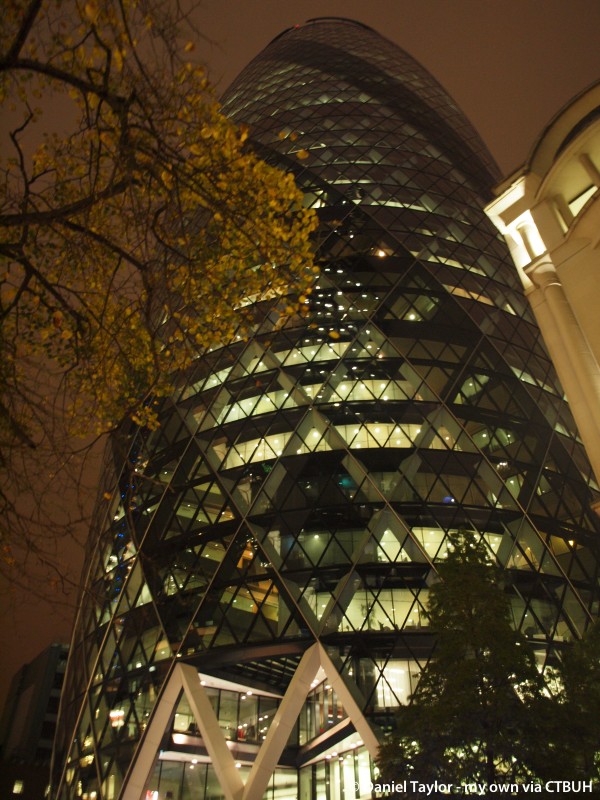
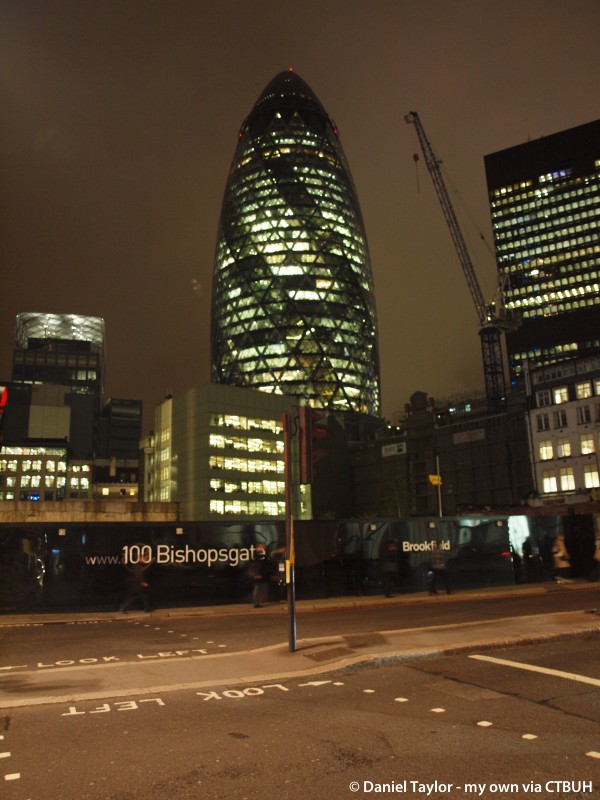
The inaugural winner of the CTBUH 10 Year award, 30 St Mary Axe (The Gherkin), helped to define a modern, open, and progressive image for one of the world’s oldest financial centers and set a benchmark in architectural quality for a new generation of tall buildings. The Gherkin has also been extraordinarily embraced by the public. In 2012, 3,000 people attended the Open City event to look inside, some queuing from 2am, with twice that number turned away. As well as appearing on a first-class stamp, the tower has been used extensively in the promotion of London through advertising, notably as the symbol of London on Olympic bid posters. The building is not only a cultural success, but a commercial one, consistently commanding higher rents than its peers in the City. Thus, the Gherkin more than satisfies the conditions for “contribution to culture / iconography.”
Under the engineering performance heading, the building’s tapering form and diagonal bracing structure have afforded numerous benefits that continue today: programmatic flexibility, naturally ventilated internal social spaces, and ample, protected public space at the ground level. The Gherkin has performed exceptionally well in high winds – its robust aerodynamic form counteracts the movement that would otherwise be felt in a building of its height. Environmentally, this form, which slims toward the base and the apex, creates external pressure differentials that are exploited to drive a system of natural ventilation during the summer months, and enabled the creation of a generous, comfortable plaza at street level, protected from high winds by the tower’s form.
The Gherkin’s accommodating structure has had follow-on benefits in the internal environment and occupant satisfaction category. Column-free floor plates, and a fully glazed façade open the building to light and views. Atria between the radiating fingers of each floor link vertically to form a series of informal break-out spaces that spiral up the building. As the occupancy has shifted from sole tenant to more than 14 firms, these “green lungs” have continued to provide valuable internal social space within the dense medieval street pattern of London. Six radial fingers of accommodation on each floor, with light wells between, combine the benefits of both curvilinear and rectilinear configurations, maximizing the proportion of naturally lit office space.
The geometry of the tower demanded an innovative system for the fabrication of individual cladding panels, due to the high level of variation. The 3D computer model of the system was linked directly to the production line, with major implications for the subsequent construction of complex buildings around the world.
The design placed a high priority on flexibility. Every possible configuration within the building, from cellular offices to entirely open plan floors, persists today. The widening and slimming profile generates a variety of floor plates that can respond to different sectors and markets.
The building is exemplary in terms of environmental and energy performance. The natural ventilation system operates by importing external air into the building through building management system (BMS)-controlled, motorized perimeter windows placed in each of the six lightwells. The adoption of natural ventilation varies, depending on tenant layout and requirements. Approximately 50 percent of occupants currently use the system.
An active, ventilated facade is used across the whole building. This comprises a low-emissivity, double-glazed clear external unit to the outside and a single-pane interior glass, separated by a ventilated cavity. Within the cavity are solar control blinds operated by the BMS. A proportion of office extract air is passed through the facade cavity, which takes the intercepted heat reflected by the blinds from the facade back to the outside via on-floor air handling units. This minimizes solar gain in the offices and makes the façade effectively part of the office extract system.
The pitch angle of the blinds is fixed by individual, BMS-controlled dedicated motors to an optimum position to reduce solar gain within the office spaces at all times, while maximizing light transmission through the gaps in the blinds. Ten years on, this system is operational and effective in providing user comfort, while reducing energy demand.
The Gherkin is not just an icon; it also provides a contribution to the urban realm beyond itself.
The outdoor space is another great success of the project, where the building’s contribution to the city has been most evident: the plaza is full of people in the summer, with food markets, city events and a dynamic arts program illustrating its success.
CVU Awards & Distinctions
10 Year Award 2013 Winner
2013 CVU Awards
Global News
30 July 2020
CTBUH In The Media: The Future of Skyscrapers: A Mile High, Slimmer Than Ever and Made from Wood
History does not want for dizzying fantasies of tall buildings. From the Tower of Babel onwards, humanity has dreamed of ever-more wondrous skyscrapers, whether we...

06 August 2019
London Skyscraper in Question as Investor Pulls Out
Asian developer Perennial Real Estate Holdings has dealt a blow to Eric Parry Architects’ approved plans to build the tallest building in the City of...

16 July 2019
Planning Permission for Proposed Tower Rejected by London Mayor
London mayor Sadiq Khan has refused the Foster + Partners designed Tulip Tower saying the 304-meter-tall tourist attraction could harm the city’s skyline. Overturning the...

27 March 2019
Tulip Tower Set for City of London Approval
City of London planning officers have recommended approval for Foster + Partners’ opinion-splitting Tulip on a site next to the Gherkin. The planned 305-meter-tall tourist...
Learn more about the Council on Vertical Urbanism
Discover how vertical living is shaping the next generation of urban environments. Explore insights, research, and global leadership in vertical urban development