




Height rank
Aqua at Lakeshore East
Chicago


stevehall-hedrich-blessing.jpg)


erichausman.jpg)
stevehall-hedrich-blessing.jpg)
stevehall-hedrich-blessing.jpg)




stevehall-hedrich-blessing.jpg)
stevehall-hedrich-blessing.jpg)
stevehall-hedrich-blessing.jpg)

stevehall-hedrich-blessing.jpg)

- CVU Drawing
- Facts
-
Metrics
You must be a CVU Member to view this resource.
To Tip:
Height is measured from the level of the lowest, significant, open-air, pedestrian entrance to the highest point of the building, irrespective of material or function of the highest element (i.e., including antennae, flagpoles, signage and other functional-technical equipment).Architectural:
Height is measured from the level of the lowest, significant, open-air, pedestrian entrance to the architectural top of the building, including spires, but not including antennae, signage, flag poles or other functional-technical equipment. This measurement is the most widely utilized and is employed to define the Council on Vertical Urbanism (CVU) rankings of the "World's Tallest Buildings."Occupied:
Height is measured from the level of the lowest, significant, open-air, pedestrian entrance to the highest occupied floor within the building.
Above Ground
The number of floors above ground should include the ground floor level and be the number of main floors above ground, including any significant mezzanine floors and major mechanical plant floors. Mechanical mezzanines should not be included if they have a significantly smaller floor area than the major floors below. Similarly, mechanical penthouses or plant rooms protruding above the general roof area should not be counted. Note: CVU floor counts may differ from published accounts, as it is common in some regions of the world for certain floor levels not to be included (e.g., the level 4, 14, 24, etc. in Hong Kong).Below Ground
The number of floors below ground should include all major floors located below the ground floor level.Official Name
Aqua at Lakeshore East
Other Names
Aqua Tower
Name of Complex
Type
Building
Status
Completed
Completion
2009
Country
City
Address
Function
A mixed-use tall building contains two or more functions (or uses), where each of the functions occupy a significant proportion of the tower's total space. Support areas such as car parks and mechanical plant space do not constitute mixed-use functions. Functions are denoted on CVU "Tallest Building" lists in descending order, e.g., "hotel/office" indicates hotel function above office function.
Residential / Hotel
Structural Material
Both the main vertical/lateral structural elements and the floor spanning systems are constructed from steel. Note that a building of steel construction with a floor system of concrete planks or concrete slab on top of steel beams is still considered an “all-steel” structure as the concrete elements are not acting as the primary structure.
All-Concrete
Both the main vertical/lateral structural elements and the floor spanning systems are constructed from concrete which has been cast in place and utilizes steel reinforcement bars and/or steel reinforced concrete which has been precast as individual components and assembled together on-site.
All-Timber
Both the main vertical/lateral structural elements and the floor spanning systems are constructed from timber. An all-timber structure may include the use of localized non-timber connections between timber elements. Note that a building of timber construction with a floor system of concrete planks or concrete slab on top of timber beams is still considered an “all-timber” structure as the concrete elements are not acting as the primary structure.
Mixed-Structure
Utilizes distinct systems (e.g. all-steel, all-concrete, all-timber), one on top of the other. For example, a Steel Over Concrete indicates an all-steel structural system located on top of an all-concrete structural system, with the opposite true of Concrete Over Steel.
Composite
A combination of materials (e.g. steel, concrete, timber) are used together in the main structural elements. Examples include buildings which utilize: steel columns with a floor system of reinforced concrete beams; a steel frame system with a concrete core; concrete-encased steel columns; concrete-filled steel tubes; etc. Where known, the CVU database breaks out the materials used within a composite building’s primary structural elements.
All-Concrete
Official Website
Height
261.8 m / 859 ft
Floors Above Ground
86
Floors Below Ground
1
# of Apartments
747
# of Hotel Rooms
334
# of Parking Spaces
1360
# of Elevators
24
Tower GFA
184,931 m² / 1,990,581 ft²
Rankings
-
By function
You must be a CVU Member to view this resource.
-
By material
You must be a CVU Member to view this resource.
Construction Schedule
Proposed
Construction Start
Completed
Structural Engineer
The Design Engineer is usually involved in the front end design, typically taking the leadership role in the Schematic Design and Design Development, and then a monitoring role through the CD and CA phases.
Contractor
The main contractor is the supervisory contractor of all construction work on a project, management of sub-contractors and vendors, etc. May be referred to as "Construction Manager," however, for consistency CTBUH uses the term "Main Contractor" exclusively.
Other Consultant
Other Consultant refers to other organizations which provided significant consultation services for a building project (e.g. wind consultants, environmental consultants, fire and life safety consultants, etc).
Other Consultant refers to other organizations which provided significant consultation services for a building project (e.g. wind consultants, environmental consultants, fire and life safety consultants, etc).
These are firms that consult on the design of a building's façade. May often be referred to as "Cladding," "Envelope," "Exterior Wall," or "Curtain Wall" Consultant, however, for consistency CTBUH uses the term "Façade Consultant" exclusively.
Material Supplier
Material Supplier refers to organizations which supplied significant systems/materials for a building project (e.g. elevator suppliers, facade suppliers, etc).
Material Supplier refers to organizations which supplied significant systems/materials for a building project (e.g. elevator suppliers, facade suppliers, etc).
You must be a CVU Member to view this resource.
Owner
Aqua Realty Holdings LLC
Developer
Magellan Development Group
Architect
Usually involved in the front end design, with a "typical" condition being that of a leadership role through either Schematic Design or Design Development, and then a monitoring role through the CD and CA phases.
Studio Gang
Usually takes on the balance of the architectural effort not executed by the "Design Architect," typically responsible for the construction documents, conforming to local codes, etc. May often be referred to as "Executive," "Associate," or "Local" Architect, however, for consistency CTBUH uses the term "Architect of Record" exclusively.
Loewenberg Architects
Structural Engineer
The Design Engineer is usually involved in the front end design, typically taking the leadership role in the Schematic Design and Design Development, and then a monitoring role through the CD and CA phases.
MEP Engineer
The Design Engineer is usually involved in the front end design, typically taking the leadership role in the Schematic Design and Design Development, and then a monitoring role through the CD and CA phases.
Abbott Industries, Inc.; Advance Mechanical; Gurtz Electric Company
Contractor
The main contractor is the supervisory contractor of all construction work on a project, management of sub-contractors and vendors, etc. May be referred to as "Construction Manager," however, for consistency CTBUH uses the term "Main Contractor" exclusively.
Other Consultant
Other Consultant refers to other organizations which provided significant consultation services for a building project (e.g. wind consultants, environmental consultants, fire and life safety consultants, etc).
Other Consultant refers to other organizations which provided significant consultation services for a building project (e.g. wind consultants, environmental consultants, fire and life safety consultants, etc).
These are firms that consult on the design of a building's façade. May often be referred to as "Cladding," "Envelope," "Exterior Wall," or "Curtain Wall" Consultant, however, for consistency CTBUH uses the term "Façade Consultant" exclusively.
Wolff Landscape Architecture
Material Supplier
Material Supplier refers to organizations which supplied significant systems/materials for a building project (e.g. elevator suppliers, facade suppliers, etc).
Material Supplier refers to organizations which supplied significant systems/materials for a building project (e.g. elevator suppliers, facade suppliers, etc).
EFCO Corporation
CVU Awards & Distinctions
Best Tall Building, by Region, Americas 2010 Award of Excellence
2010 CVU Awards
Global News

20 October 2020
James Loewenberg, Developer of Chicago High-Rises, Dies at 86
James Loewenberg, a Chicago architect-turned-developer with a portfolio that includes the Aqua and Vista Tower skyscrapers in downtown Chicago, has died at age 86 after...
About Aqua at Lakeshore East
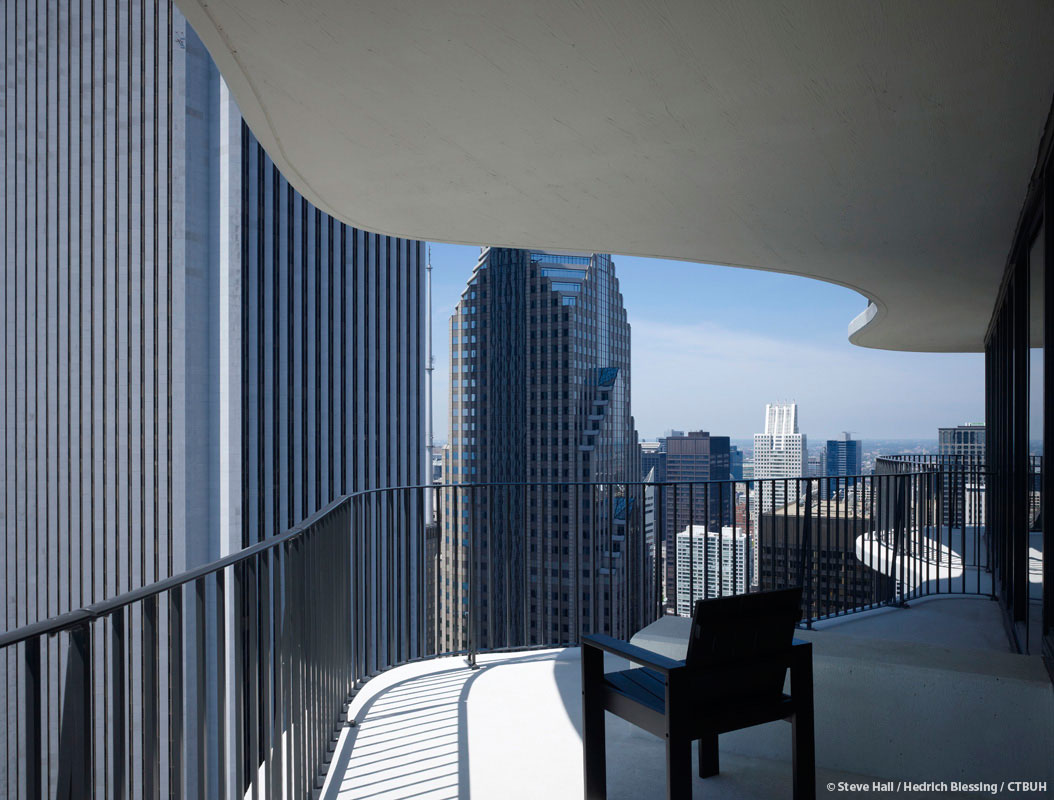
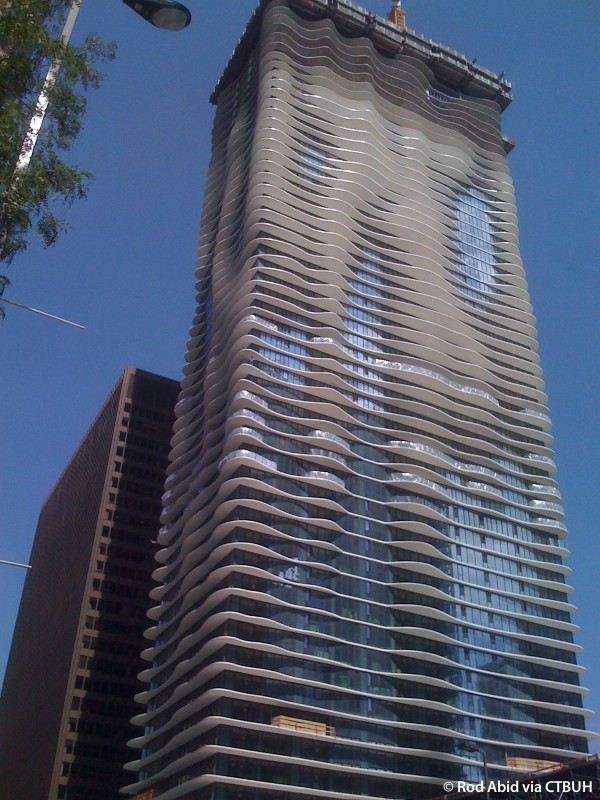
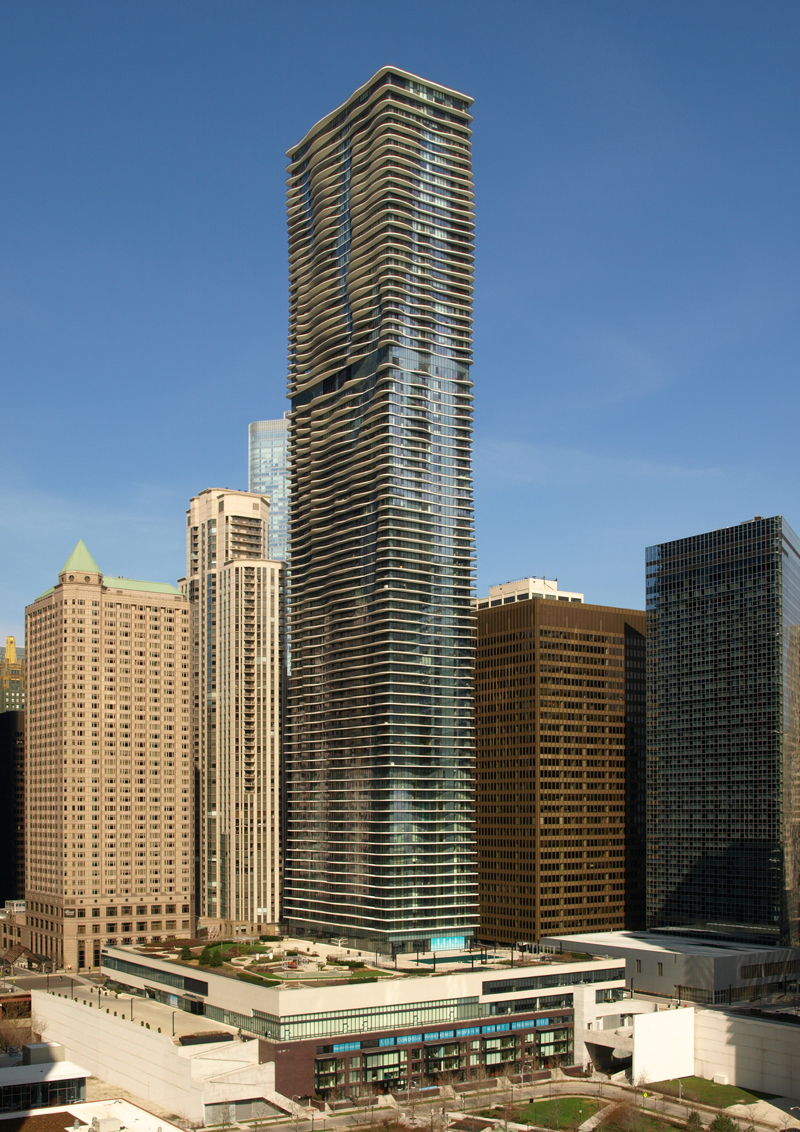
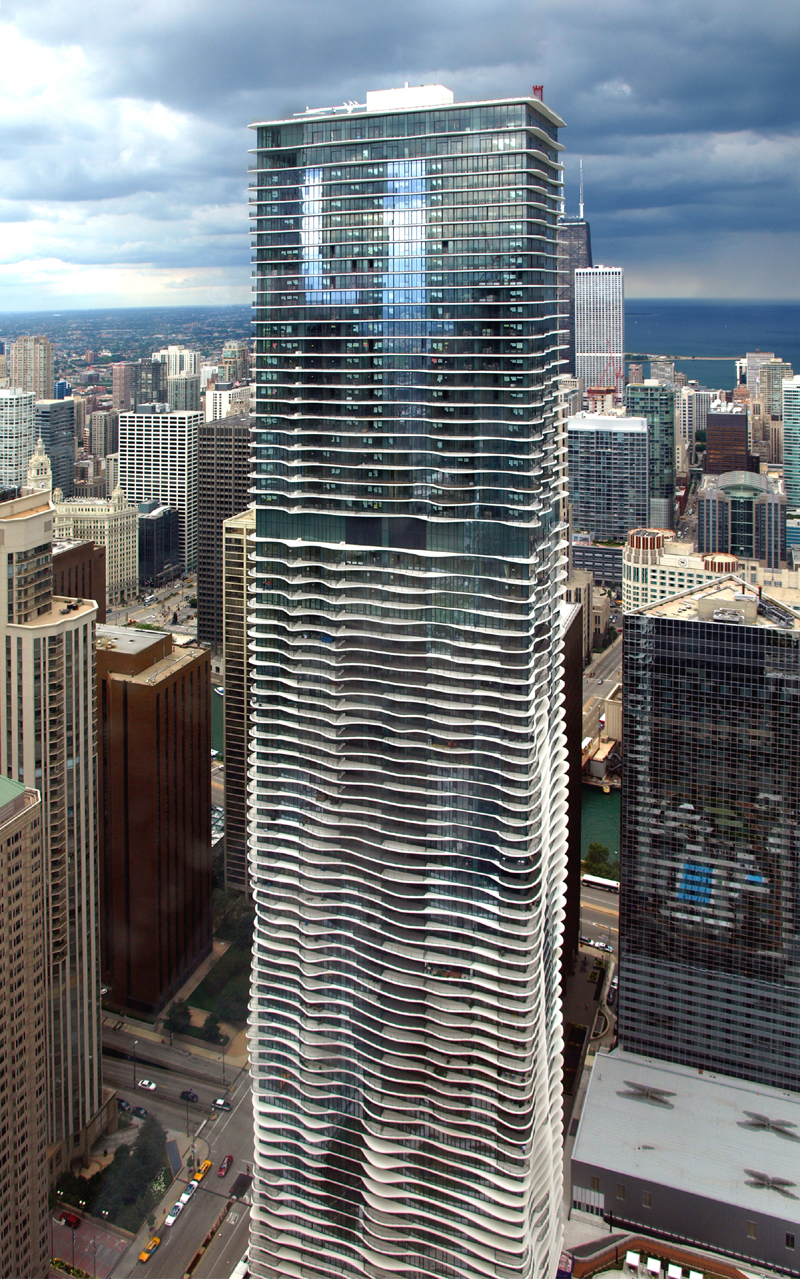
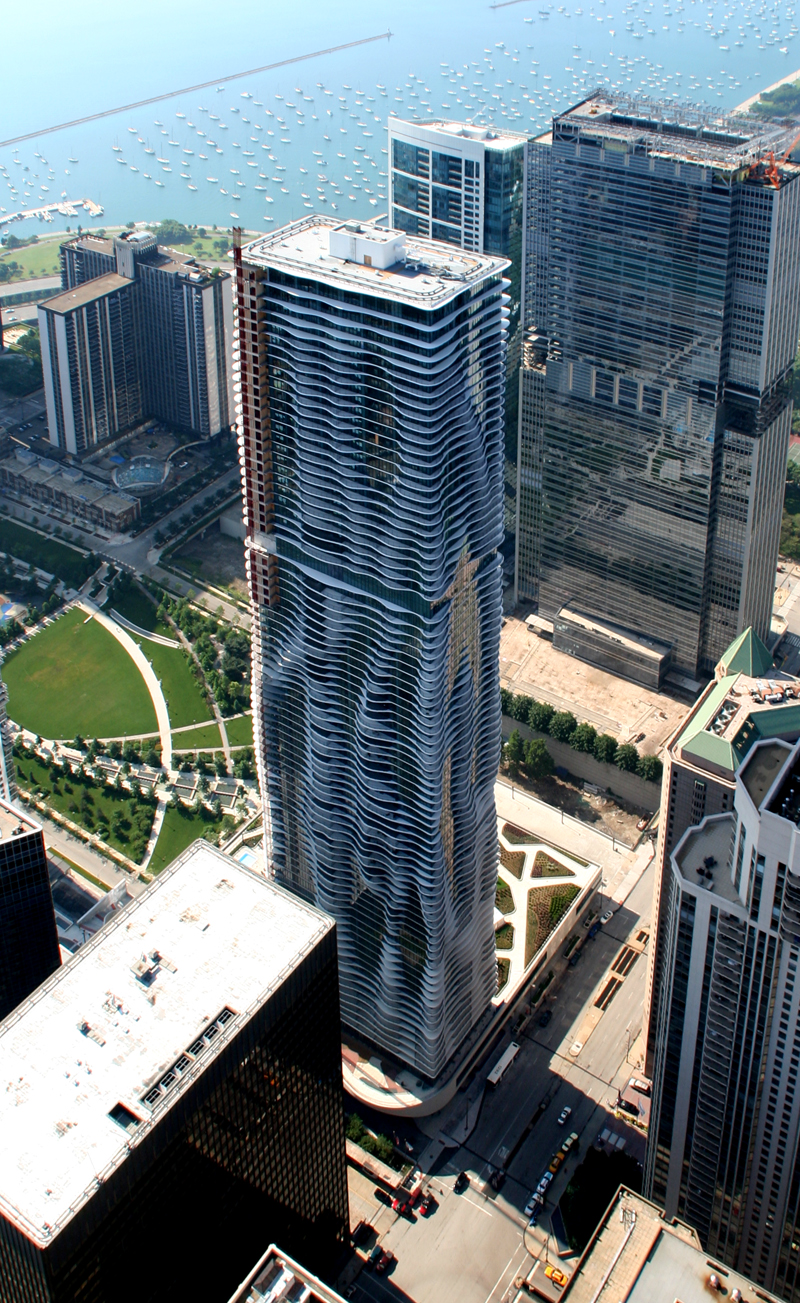
Unlike a tower in an open field, new towers in urban environments must negotiate small viewing corridors between existing buildings. In response to this, the Aqua Tower is designed to capture particular views that would otherwise be unattainable. A series of contours defined by outdoor terraces extends away from the face of the tower structure to provide views between neighboring buildings. The terraces inflect based on criteria such as the view, solar shading and size and type of dwelling. When viewed together, these unique terraces make the building appear to undulate, presenting a highly sculptural appearance that is rooted in function.
These outdoor terraces are cantilevered up to 4m (12ft) and have a depth of 23cm (9in) which thins out towards the edge of the cantilever to assist with water drainage. The terraces differ in shape from floor to floor causing each floor plate to differ. The challenge of constructing unique floor plates was solved by implementing a computerized civil engineering and surveying software program and digital CAD files for inputting the coordinates of each unique slab to a robotic station used onsite. This system was used to set in place light-gauge steel plate edge-forms according to the contours. After the concrete had set, these steel forms would be removed and easily reshaped according to the contours of the next level.
Among the building’s notable features is the green roof terrace atop its plinth and is one of Chicago’s largest. It contains an outdoor pool, running track, gardens, fire pits and a yoga terrace. From below, Aqua’s plinth navigates the site’s complexity by spanning over pre-existing elements, such as an electrical substation, and by aligning with existing infrastructure, including an adjacent three-level roadway. The plinth physically connects pedestrian areas with stairs and elevators linking street level to park level and the lakefront.
The tower’s east–west orientation maximizes its winter solar performance. Its balconies extend further on the southern façade to provide shading, reducing solar exposure in summer and allowing passive warming in winter. In addition to low-E coatings on all glass, the design team modeled seasonal sun patterns to identify remaining areas of glass that needed higher performing glazing to increase energy efficiency throughout the tower. Glass on the east and south façades are reflective in areas without a protective balcony, while glass facing west has a tinted coating that improves its shading coefficient. In total, Aqua employs six different types of glass: clear, tinted, reflective, spandrel, fritted and translucent, the placement of which is determined by the orientation and function of interior space. Fritted glass is used and combined with handrail design to minimize bird strikes.
The building is also constructed on a former brownfield site, and 50% of its site is dedicated green open space, exceeding Chicago’s standard zoning ordinance by 25%. This green roof is one of the largest in the city and also features a drainage system that includes water collection for its irrigation. Furthermore, Aqua exceeds the City of Chicago’s minimal requirements for natural ventilation and sunlight by more than 50% in over 90% of its spaces.
Detailed wind tunnel studies were completed to confirm the performance of the structure under high winds. Initially, it was thought that a supplemental tuned mass damping system may be required to appropriately manage the effects of the wind on occupant comfort. However, during the testing, it was discovered that the undulating slab edges disrupted or “confused” the flow of wind around the tower, effectively reducing the wind demands, and this, combined with the effectiveness of the structural design, eliminated the need for a supplemental damping system.
CVU Awards & Distinctions
Best Tall Building, by Region, Americas 2010 Award of Excellence
2010 CVU Awards
Global News
20 October 2020
James Loewenberg, Developer of Chicago High-Rises, Dies at 86
James Loewenberg, a Chicago architect-turned-developer with a portfolio that includes the Aqua and Vista Tower skyscrapers in downtown Chicago, has died at age 86 after...

31 March 2020
Architecture Firm in Chicago Uses 3D Printer to Create Face Masks for Healthcare Workers
bKL Architecture, a firm headquartered at the Aqua tower in Chicago's Lakeshore East neighborhood, is doing its part to be of service during the COVID-19...
Learn more about the Council on Vertical Urbanism
Discover how vertical living is shaping the next generation of urban environments. Explore insights, research, and global leadership in vertical urban development