




Height rank
Cayan Tower
Dubai


tonysafarik.jpg)


som_tim_griffith.jpg)
som_tim_griffith.jpg)
tonysafarik.jpg)
tonysafarik.jpg)
tim_griffith.jpg)
som_tim_griffith.jpg)
cayan__group.jpg)
som_tim_griffith.jpg)
som_tim_griffith.jpg)
cayan__group.jpg)
cayan__group.jpg)
cayan__group.jpg)
imresolt.jpg)
imresolt.jpg)
imresolt.jpg)
imresolt.jpg)
imresolt.jpg)
imresolt.jpg)

Cayan__Group.jpg)


- CVU Drawing
- Facts
-
Metrics
You must be a CVU Member to view this resource.
To Tip:
Height is measured from the level of the lowest, significant, open-air, pedestrian entrance to the highest point of the building, irrespective of material or function of the highest element (i.e., including antennae, flagpoles, signage and other functional-technical equipment).Architectural:
Height is measured from the level of the lowest, significant, open-air, pedestrian entrance to the architectural top of the building, including spires, but not including antennae, signage, flag poles or other functional-technical equipment. This measurement is the most widely utilized and is employed to define the Council on Vertical Urbanism (CVU) rankings of the "World's Tallest Buildings."Occupied:
Height is measured from the level of the lowest, significant, open-air, pedestrian entrance to the highest occupied floor within the building.
Above Ground
The number of floors above ground should include the ground floor level and be the number of main floors above ground, including any significant mezzanine floors and major mechanical plant floors. Mechanical mezzanines should not be included if they have a significantly smaller floor area than the major floors below. Similarly, mechanical penthouses or plant rooms protruding above the general roof area should not be counted. Note: CVU floor counts may differ from published accounts, as it is common in some regions of the world for certain floor levels not to be included (e.g., the level 4, 14, 24, etc. in Hong Kong).Below Ground
The number of floors below ground should include all major floors located below the ground floor level.Official Name
Cayan Tower
Other Names
Infinity Tower
Type
Building
Status
Completed
Completion
2013
Country
City
Address
Function
A mixed-use tall building contains two or more functions (or uses), where each of the functions occupy a significant proportion of the tower's total space. Support areas such as car parks and mechanical plant space do not constitute mixed-use functions. Functions are denoted on CVU "Tallest Building" lists in descending order, e.g., "hotel/office" indicates hotel function above office function.
Residential
Structural Material
Both the main vertical/lateral structural elements and the floor spanning systems are constructed from steel. Note that a building of steel construction with a floor system of concrete planks or concrete slab on top of steel beams is still considered an “all-steel” structure as the concrete elements are not acting as the primary structure.
All-Concrete
Both the main vertical/lateral structural elements and the floor spanning systems are constructed from concrete which has been cast in place and utilizes steel reinforcement bars and/or steel reinforced concrete which has been precast as individual components and assembled together on-site.
All-Timber
Both the main vertical/lateral structural elements and the floor spanning systems are constructed from timber. An all-timber structure may include the use of localized non-timber connections between timber elements. Note that a building of timber construction with a floor system of concrete planks or concrete slab on top of timber beams is still considered an “all-timber” structure as the concrete elements are not acting as the primary structure.
Mixed-Structure
Utilizes distinct systems (e.g. all-steel, all-concrete, all-timber), one on top of the other. For example, a Steel Over Concrete indicates an all-steel structural system located on top of an all-concrete structural system, with the opposite true of Concrete Over Steel.
Composite
A combination of materials (e.g. steel, concrete, timber) are used together in the main structural elements. Examples include buildings which utilize: steel columns with a floor system of reinforced concrete beams; a steel frame system with a concrete core; concrete-encased steel columns; concrete-filled steel tubes; etc. Where known, the CVU database breaks out the materials used within a composite building’s primary structural elements.
All-Concrete
Official Website
Height
306.4 m / 1,005 ft
Floors Above Ground
73
Floors Below Ground
5
# of Apartments
495
# of Parking Spaces
623
# of Elevators
7
Top Elevator Speed
8 m/s
Tower GFA
111,000 m² / 1,194,794 ft²
Rankings
-
By function
You must be a CVU Member to view this resource.
-
By material
You must be a CVU Member to view this resource.
Construction Schedule
Proposed
Construction Start
Completed
Architect
Usually involved in the front end design, with a "typical" condition being that of a leadership role through either Schematic Design or Design Development, and then a monitoring role through the CD and CA phases.
Structural Engineer
The Design Engineer is usually involved in the front end design, typically taking the leadership role in the Schematic Design and Design Development, and then a monitoring role through the CD and CA phases.
MEP Engineer
The Design Engineer is usually involved in the front end design, typically taking the leadership role in the Schematic Design and Design Development, and then a monitoring role through the CD and CA phases.
Other Consultant
Other Consultant refers to other organizations which provided significant consultation services for a building project (e.g. wind consultants, environmental consultants, fire and life safety consultants, etc).
Other Consultant refers to other organizations which provided significant consultation services for a building project (e.g. wind consultants, environmental consultants, fire and life safety consultants, etc).
Material Supplier
Material Supplier refers to organizations which supplied significant systems/materials for a building project (e.g. elevator suppliers, facade suppliers, etc).
Material Supplier refers to organizations which supplied significant systems/materials for a building project (e.g. elevator suppliers, facade suppliers, etc).
You must be a CVU Member to view this resource.
Owner/Developer
Cayan Group - Real Estate Investment & Development
Architect
Usually involved in the front end design, with a "typical" condition being that of a leadership role through either Schematic Design or Design Development, and then a monitoring role through the CD and CA phases.
Usually takes on the balance of the architectural effort not executed by the "Design Architect," typically responsible for the construction documents, conforming to local codes, etc. May often be referred to as "Executive," "Associate," or "Local" Architect, however, for consistency CTBUH uses the term "Architect of Record" exclusively.
Khatib & Alami
Structural Engineer
The Design Engineer is usually involved in the front end design, typically taking the leadership role in the Schematic Design and Design Development, and then a monitoring role through the CD and CA phases.
The Engineer of Record takes the balance of the engineering effort not executed by the “Design Engineer,” typically responsible for construction documents, conforming to local codes, etc.
Khatib & Alami
MEP Engineer
The Design Engineer is usually involved in the front end design, typically taking the leadership role in the Schematic Design and Design Development, and then a monitoring role through the CD and CA phases.
Project Manager
The CTBUH lists a project manager when a specific firm has been commissioned to oversee this aspect of a tall building’s design/construction. When the project management efforts are handled by the developer, main contract, or architect, this field will be omitted.
The CTBUH lists a project manager when a specific firm has been commissioned to oversee this aspect of a tall building’s design/construction. When the project management efforts are handled by the developer, main contract, or architect, this field will be omitted.
Currie & Brown
Contractor
The main contractor is the supervisory contractor of all construction work on a project, management of sub-contractors and vendors, etc. May be referred to as "Construction Manager," however, for consistency CTBUH uses the term "Main Contractor" exclusively.
Arabtec
Other Consultant
Other Consultant refers to other organizations which provided significant consultation services for a building project (e.g. wind consultants, environmental consultants, fire and life safety consultants, etc).
Other Consultant refers to other organizations which provided significant consultation services for a building project (e.g. wind consultants, environmental consultants, fire and life safety consultants, etc).
Cerami & Associates; Shen Milsom Wilke, Inc.
Rotana Hotel Management Corporation PJSC
Opening Solutions, Inc.; Van Deusen & Associates
Material Supplier
Material Supplier refers to organizations which supplied significant systems/materials for a building project (e.g. elevator suppliers, facade suppliers, etc).
Material Supplier refers to organizations which supplied significant systems/materials for a building project (e.g. elevator suppliers, facade suppliers, etc).
CSG Architectural Glass; Jangho Group Co., Ltd.
Facade Lighting Services
CVU Awards & Distinctions
Best Tall Building, by Region, Middle East & Africa 2014 Winner
2014 CVU Awards
About Cayan Tower
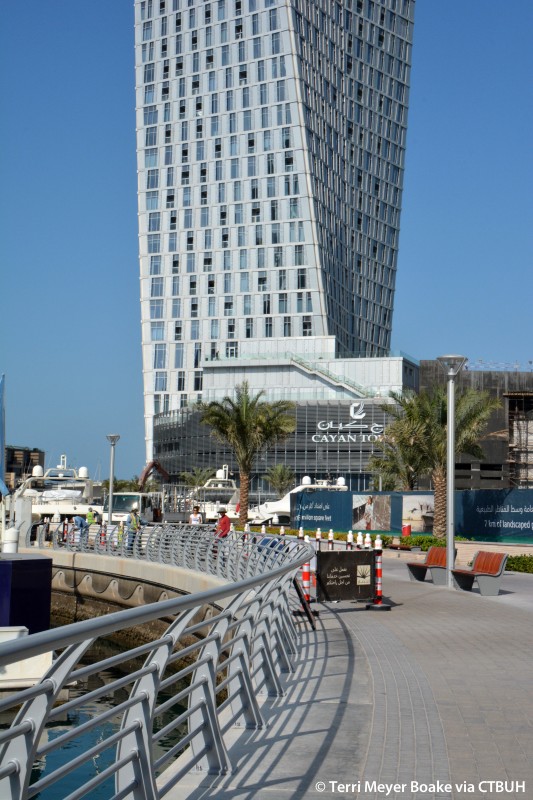
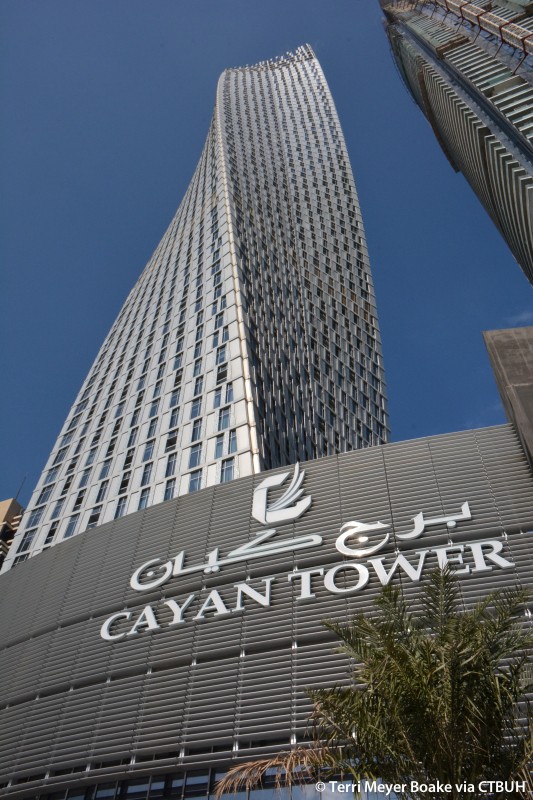
The Cayan Tower is a luxury apartment building with a striking helical shape, turning 90 degrees over the course of its height. Each floor is identical in plan, but is set 1.2 degrees clockwise from the floor below, giving the tower a distinctive form by way of an innovative, efficient, repeatable structure. Its shape is pure expression of the relationship between a building’s form and the structural framework that supports it.
Aesthetically, the twisting shape makes the building stand out from the architectural disharmony of the Dubai waterfront, which is largely composed of indistinct towers that do not speak to their location. Located near Dubai Internet City, Emirates Golf Club, and numerous corporate headquarters, the tower’s twisting form provides a greater number of units with desirable views of the Dubai Marina and Arabian Gulf, while also preserving the views for residents living in neighboring buildings, ensuring that Cayan Tower enhances its spectacular waterfront site.
The tower’s structural system is a cast-in-place, high-strength, reinforced-concrete column superstructure. The shape and size of the columns were determined through the use of wind-tunnel testing and three-dimensional computer modeling to analyze building stresses. The building core is a cylindrical concrete form that acts as the central pillar for the tower. As the building ascends, the rotation at each floor occurs around this central mass. The building was constructed using a “jump form” system that takes advantage of its repetitive nature. Even so, construction took seven years.
Within the tower, the units have been divided into six unique types, offering ample living space configurations to residents. Standard units range from studios to three-bedrooms, and the crown of the building features six levels of both half- and full-floor penthouses. Residential amenities include an outdoor infinity edge pool facing the marina, flexible spaces on the sixth floor, a health spa, exercise facility, and conference centers.
On the ground plane, the tower acts as an urban gateway, connecting the Arabian Gulf, the Dubai Marina, and the city beyond. It also provides a visual point of reference on the city skyline. The building appears to change from every angle, giving it a sense of movement regardless of the viewer’s vantage point. Within the marina, the public can experience this design detail firsthand by walking along the waterside promenade that edges the tower’s site. A retail colonnade, located at the tower’s base, also provides visitors with shopping, shade, and views out toward the water.
The tower’s twisting shape is designed for enhanced indoor comfort. Its twist generates self-shading for the tower, ensuring that many of the interior spaces are protected from solar exposure. The building’s exterior terraces and the façade’s metal cladding panels, high-performance glass, and deep sills around the recessed glass line further protect the building from direct solar radiation, while providing diffuse daylight to interior spaces. This enhanced design for solar control reduces the building’s demand for cooling, provides a thermally comfortable environment, and minimizes the risk of glare, while optimizing occupant views of the surrounding marina environment and gulf.
The tower’s HVAC system has been specially designed to deal with desert conditions. A central dedicated outside air system equipped with sand filters and heat pipes distributes fresh air across the tower. Fan coil units within the occupied space satisfy the cooling load while providing additional local filtering to reduce the level of fine particles entering through the façade.
The tower’s helical form also acts as a shield from the northerly diurnal winds, which often carry sand and dust, thus minimizing the fine particles that may flow through the façade and impact indoor air quality. When outdoor conditions allow, windows can be opened so that natural ventilation can provide fresh air and passive cooling in interior spaces. At night, when cool winds blow from east and west, a separate system that passively cools the tower’s slabs helps the building discharge excess heat. Outside air is naturally brought into the space and used to “purge” heat absorbed by the tower’s exposed slabs during the warmer day hours. This cools down the thermal mass and restores the slabs’ thermal properties, enabling them to again absorb heat during the following day.
CVU Awards & Distinctions
Best Tall Building, by Region, Middle East & Africa 2014 Winner
2014 CVU Awards
Learn more about the Council on Vertical Urbanism
Discover how vertical living is shaping the next generation of urban environments. Explore insights, research, and global leadership in vertical urban development