




Height rank
Eight Spruce Street
New York City






- CVU Drawing
- Facts
-
Metrics
You must be a CVU Member to view this resource.
To Tip:
Height is measured from the level of the lowest, significant, open-air, pedestrian entrance to the highest point of the building, irrespective of material or function of the highest element (i.e., including antennae, flagpoles, signage and other functional-technical equipment).Architectural:
Height is measured from the level of the lowest, significant, open-air, pedestrian entrance to the architectural top of the building, including spires, but not including antennae, signage, flag poles or other functional-technical equipment. This measurement is the most widely utilized and is employed to define the Council on Vertical Urbanism (CVU) rankings of the "World's Tallest Buildings."Occupied:
Height is measured from the level of the lowest, significant, open-air, pedestrian entrance to the highest occupied floor within the building.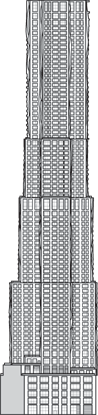
Above Ground
The number of floors above ground should include the ground floor level and be the number of main floors above ground, including any significant mezzanine floors and major mechanical plant floors. Mechanical mezzanines should not be included if they have a significantly smaller floor area than the major floors below. Similarly, mechanical penthouses or plant rooms protruding above the general roof area should not be counted. Note: CVU floor counts may differ from published accounts, as it is common in some regions of the world for certain floor levels not to be included (e.g., the level 4, 14, 24, etc. in Hong Kong).Below Ground
The number of floors below ground should include all major floors located below the ground floor level.Official Name
Eight Spruce Street
Other Names
New York by Gehry at Eight Spruce Street, Beekman Tower, Beekman Place, The Beekman
Type
Building
Status
Completed
Completion
2011
Country
City
Address
Function
A mixed-use tall building contains two or more functions (or uses), where each of the functions occupy a significant proportion of the tower's total space. Support areas such as car parks and mechanical plant space do not constitute mixed-use functions. Functions are denoted on CVU "Tallest Building" lists in descending order, e.g., "hotel/office" indicates hotel function above office function.
Residential
Structural Material
Both the main vertical/lateral structural elements and the floor spanning systems are constructed from steel. Note that a building of steel construction with a floor system of concrete planks or concrete slab on top of steel beams is still considered an “all-steel” structure as the concrete elements are not acting as the primary structure.
All-Concrete
Both the main vertical/lateral structural elements and the floor spanning systems are constructed from concrete which has been cast in place and utilizes steel reinforcement bars and/or steel reinforced concrete which has been precast as individual components and assembled together on-site.
All-Timber
Both the main vertical/lateral structural elements and the floor spanning systems are constructed from timber. An all-timber structure may include the use of localized non-timber connections between timber elements. Note that a building of timber construction with a floor system of concrete planks or concrete slab on top of timber beams is still considered an “all-timber” structure as the concrete elements are not acting as the primary structure.
Mixed-Structure
Utilizes distinct systems (e.g. all-steel, all-concrete, all-timber), one on top of the other. For example, a Steel Over Concrete indicates an all-steel structural system located on top of an all-concrete structural system, with the opposite true of Concrete Over Steel.
Composite
A combination of materials (e.g. steel, concrete, timber) are used together in the main structural elements. Examples include buildings which utilize: steel columns with a floor system of reinforced concrete beams; a steel frame system with a concrete core; concrete-encased steel columns; concrete-filled steel tubes; etc. Where known, the CVU database breaks out the materials used within a composite building’s primary structural elements.
All-Concrete
Official Website
Height
265.2 m / 870 ft
Floors Above Ground
76
Floors Below Ground
1
# of Apartments
903
# of Parking Spaces
175
# of Elevators
15
Top Elevator Speed
7.1 m/s
Tower GFA
92,903 m² / 1,000,000 ft²
Rankings
-
By function
You must be a CVU Member to view this resource.
-
By material
You must be a CVU Member to view this resource.
Construction Schedule
Proposed
Construction Start
Completed
Owner/Developer
Structural Engineer
The Design Engineer is usually involved in the front end design, typically taking the leadership role in the Schematic Design and Design Development, and then a monitoring role through the CD and CA phases.
MEP Engineer
The Design Engineer is usually involved in the front end design, typically taking the leadership role in the Schematic Design and Design Development, and then a monitoring role through the CD and CA phases.
Other Consultant
Other Consultant refers to other organizations which provided significant consultation services for a building project (e.g. wind consultants, environmental consultants, fire and life safety consultants, etc).
Other Consultant refers to other organizations which provided significant consultation services for a building project (e.g. wind consultants, environmental consultants, fire and life safety consultants, etc).
These are firms that consult on the design of a building's façade. May often be referred to as "Cladding," "Envelope," "Exterior Wall," or "Curtain Wall" Consultant, however, for consistency CTBUH uses the term "Façade Consultant" exclusively.
Material Supplier
Material Supplier refers to organizations which supplied significant systems/materials for a building project (e.g. elevator suppliers, facade suppliers, etc).
Material Supplier refers to organizations which supplied significant systems/materials for a building project (e.g. elevator suppliers, facade suppliers, etc).
You must be a CVU Member to view this resource.
Owner/Developer
Architect
Usually involved in the front end design, with a "typical" condition being that of a leadership role through either Schematic Design or Design Development, and then a monitoring role through the CD and CA phases.
Gehry Partners
Structural Engineer
The Design Engineer is usually involved in the front end design, typically taking the leadership role in the Schematic Design and Design Development, and then a monitoring role through the CD and CA phases.
MEP Engineer
The Design Engineer is usually involved in the front end design, typically taking the leadership role in the Schematic Design and Design Development, and then a monitoring role through the CD and CA phases.
Contractor
The main contractor is the supervisory contractor of all construction work on a project, management of sub-contractors and vendors, etc. May be referred to as "Construction Manager," however, for consistency CTBUH uses the term "Main Contractor" exclusively.
Kreisler Borg Florman General Construction Company
Other Consultant
Other Consultant refers to other organizations which provided significant consultation services for a building project (e.g. wind consultants, environmental consultants, fire and life safety consultants, etc).
Other Consultant refers to other organizations which provided significant consultation services for a building project (e.g. wind consultants, environmental consultants, fire and life safety consultants, etc).
These are firms that consult on the design of a building's façade. May often be referred to as "Cladding," "Envelope," "Exterior Wall," or "Curtain Wall" Consultant, however, for consistency CTBUH uses the term "Façade Consultant" exclusively.
Material Supplier
Material Supplier refers to organizations which supplied significant systems/materials for a building project (e.g. elevator suppliers, facade suppliers, etc).
Material Supplier refers to organizations which supplied significant systems/materials for a building project (e.g. elevator suppliers, facade suppliers, etc).
CVU Awards & Distinctions
Best Tall Building, by Region, Americas 2011 Winner
2011 CVU Awards
About Eight Spruce Street
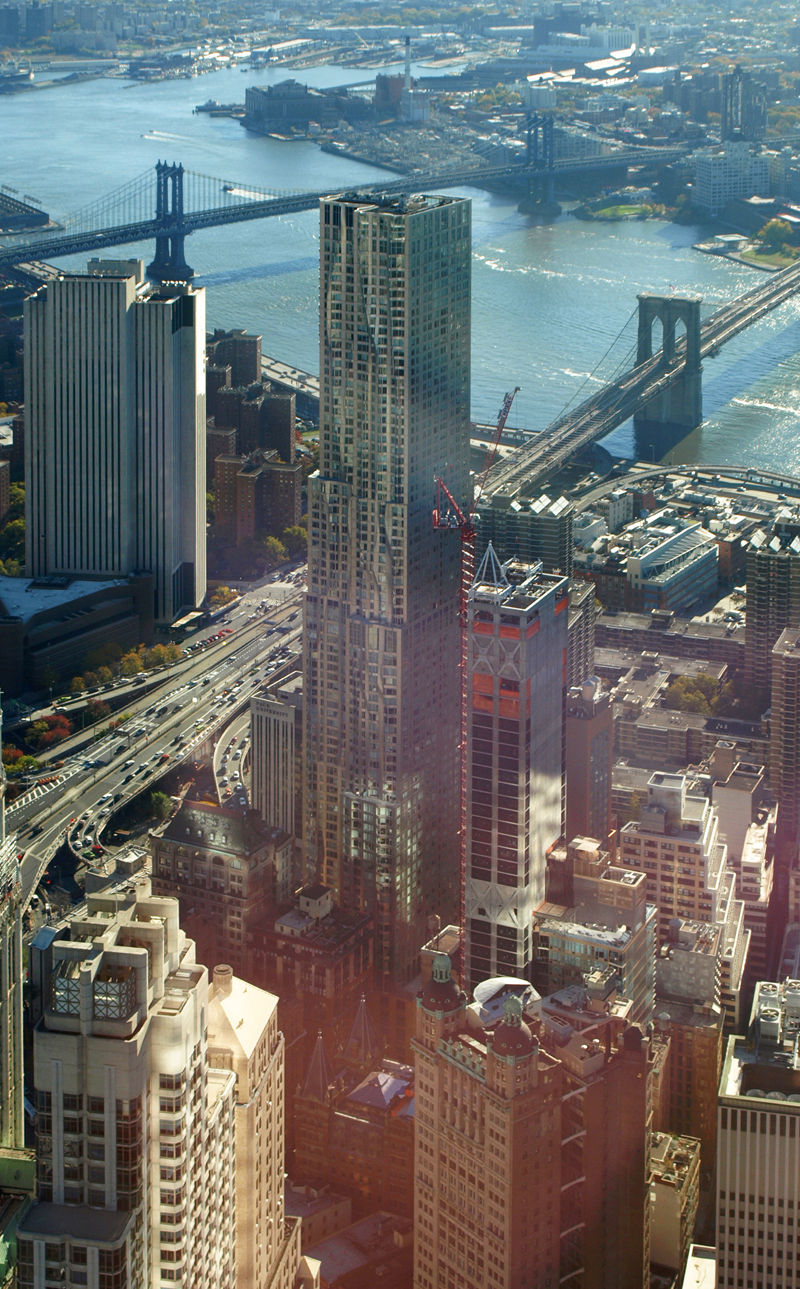
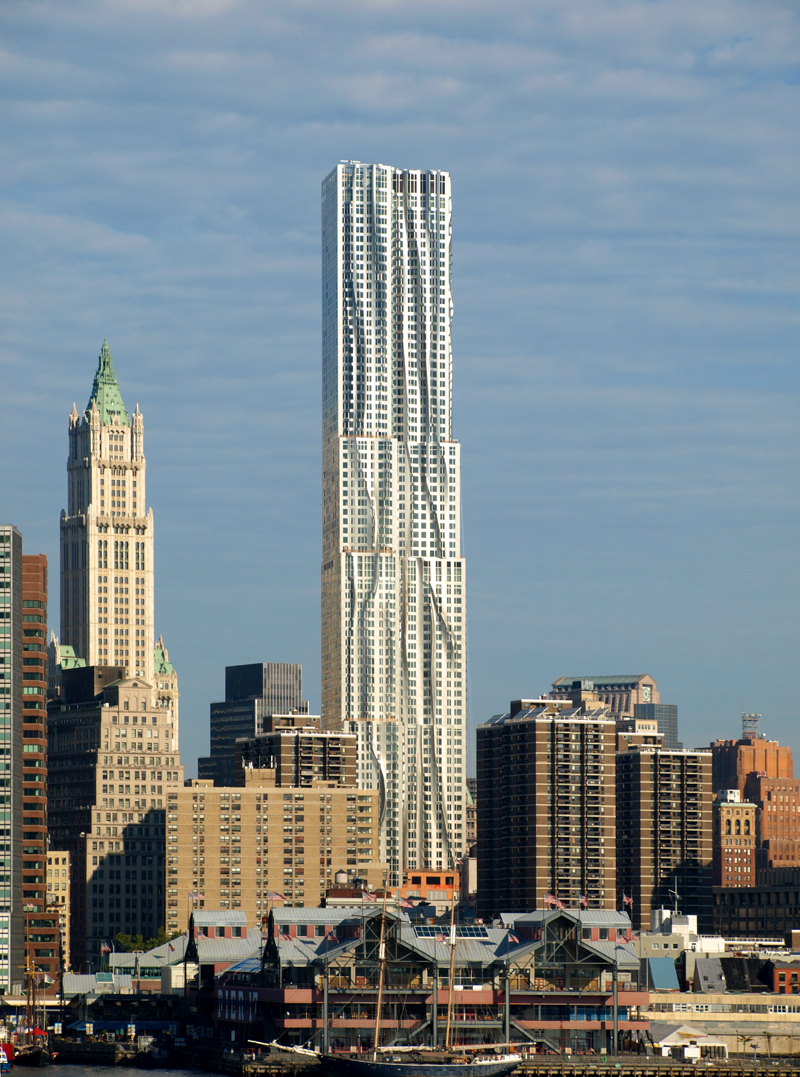
Eight Spruce Street is located in a part of lower Manhattan with few other towers. It is close to City Hall and its adjacent park. The landmark Woolworth Building by Cass Gilbert and the Brooklyn Bridge are its closest neighbors. Its significant height make 8 Spruce Street a prominent addition to the New York City skyline and as the tallest all-residential building in North America adds a significant residential population to its neighborhood. In addition to its 900 residential units, the tower also houses a pre-kindergarten through eighth grade public school, and office space for the New York Downtown Hospital in its base.
The site sits between Spruce Street on the north and Beekman Street on the south, formerly a 100% impervious asphalt topped parking lot. The new project and site design minimizes the building footprint to enable 30% of the site to be developed as landscaped urban plazas which create through block pedestrian spaces on both the east and west sides of the building. These spaces contain outdoor amenities such as landscaping, water features and public seating areas. The West Plaza creates a landscaped setting for a porte cochere that gives car and pedestrian access to the residential lobby.
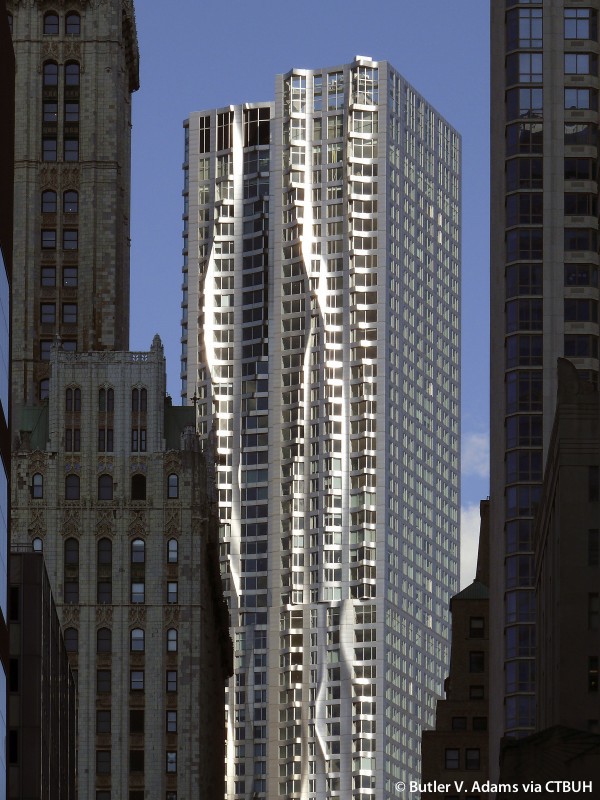
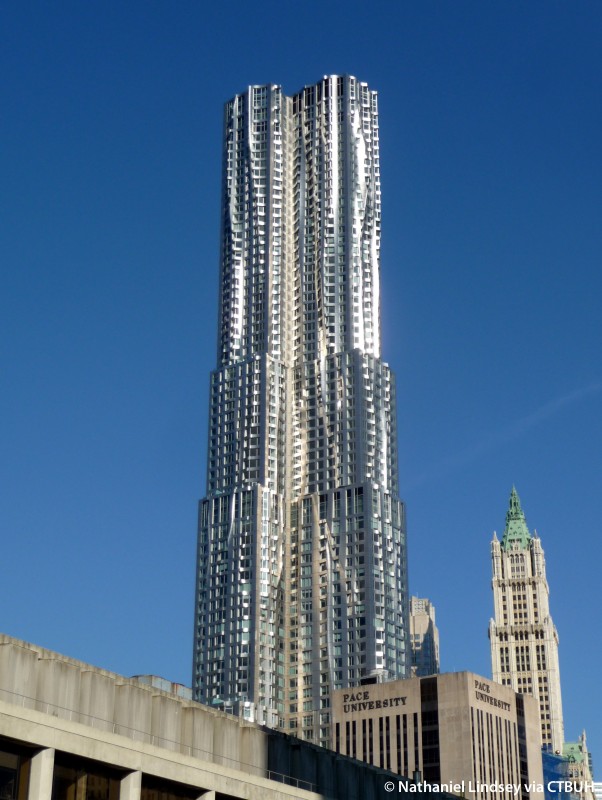
The development of the form began by using the classical proportions of New York City towers and the traditional setback rules which have created the tall wedding cake designs typical in the city. These guidelines created the initial massing of the building. Then the design developed to accommodate bay windows which the client requested in each unit. Rather than having the bay windows align vertically, they are shifted slightly from floor-to-floor and varied in size from unit-to-unit. The initial massing studies revealed that this created the look of fabric draping over the building, so the design was developed to accentuate this effect utilizing cladding in flat and undulating stainless steel panels. Seven sides of the tower have this configuration, while the south side of the tower is sheared into a flat plane that contrasts the curvature of the other façades and strengthens the sculptural composition. At the base of the tower a simple five-story brick podium ties the tower to the scale and spirit of the neighboring buildings.
Due to the undulating façade each floor of the tower and each residential unit on the seven undulating sides has a different configuration. The apartment interiors were carefully designed to take best advantage of these unique conditions, with large windows framing views and creating window seats on some of the large window sills that are created by the movement of the wall from floor to floor. The bay windows also afford residents the opportunity to step out past the plane of the exterior wall in what the architect has coined “stepping into space” and to have the feeling of being suspended over the whole of Manhattan. The apartments range in size from 450 sq ft (41 sq m) studios to 1,700 sq ft (158 sq m) three bedroom apartments at the top of the tower. All residential units are provided with natural light and natural ventilation to minmize the demands on artificial ventilation and lighting, further, natural daylight is provided for in three quarters of the buildings residential corridors.
The tower was designed using software developed by Gehry Technologies called Digital Project. The software enabled cost and fabrication information to be automatically produced as part of every design iteration, which allowed the design team to optimize the design quality while continually meeting the client’s budget. The project’s exterior wall was completely documented in the 3D computer model. The curtain wall geometries were rationalized into three types of geometries—standard flat panels, moderately shaped panels, and highly shaped panels. The software enabled the designers to apportion the complexity to within the client’s budget. The shop drawings were produced automatically from the digital model and connected directly to the fabricator’s production machinery. This streamlined communication and removed errors. Because of this tight coordination from design through fabrication, there were zero change orders from the contractor on the curtain wall, a significant cost saver on the project.
All new parking is provided on the site underground helping to reduce the impervious site surface. The parking garage mechanical system is designed as a demand control ventilation system. Air flow increases within the parking garage as Carbon dioxide is detected within the garage. This system minimizes the amount of energy used to operate the system.
Several strategies were implemented in the design to reduce energy consumption in the tower. All components of the exterior curtain wall assembly are thermally broken and high-performance insulated glass was used at all glazed openings, minimizing heat loss through the exterior wall system. Light reflecting pavers were used on all roofs to minimize the amount of heat gain to the building and create a thermally protected roof slab. Radiant floor heating is provided in the public spaces to minimize the excessive loading on the mechanical systems and high efficient linear fluorescent light fixtures are used through the residential corridors.
CVU Awards & Distinctions
Best Tall Building, by Region, Americas 2011 Winner
2011 CVU Awards
Learn more about the Council on Vertical Urbanism
Discover how vertical living is shaping the next generation of urban environments. Explore insights, research, and global leadership in vertical urban development