




Height rank
FKI Tower
Seoul





adriansmithgordongill.jpg)
adriansmithgordongill.jpg)
adriansmithgordongill.jpg)
adriansmithgordongill.jpg)
adriansmithgordongill.jpg)
as_gg_namgoongsun.jpg)



- CVU Drawing
- Facts
-
Metrics
You must be a CVU Member to view this resource.
To Tip:
Height is measured from the level of the lowest, significant, open-air, pedestrian entrance to the highest point of the building, irrespective of material or function of the highest element (i.e., including antennae, flagpoles, signage and other functional-technical equipment).Architectural:
Height is measured from the level of the lowest, significant, open-air, pedestrian entrance to the architectural top of the building, including spires, but not including antennae, signage, flag poles or other functional-technical equipment. This measurement is the most widely utilized and is employed to define the Council on Vertical Urbanism (CVU) rankings of the "World's Tallest Buildings."Occupied:
Height is measured from the level of the lowest, significant, open-air, pedestrian entrance to the highest occupied floor within the building.Above Ground
The number of floors above ground should include the ground floor level and be the number of main floors above ground, including any significant mezzanine floors and major mechanical plant floors. Mechanical mezzanines should not be included if they have a significantly smaller floor area than the major floors below. Similarly, mechanical penthouses or plant rooms protruding above the general roof area should not be counted. Note: CVU floor counts may differ from published accounts, as it is common in some regions of the world for certain floor levels not to be included (e.g., the level 4, 14, 24, etc. in Hong Kong).Below Ground
The number of floors below ground should include all major floors located below the ground floor level.
Official Name
FKI Tower
Other Names
FKI Head Office Building, Federation of Korean Industries Head Office Building
Type
Building
Status
Completed
Completion
2013
Country
City
Address
Function
A mixed-use tall building contains two or more functions (or uses), where each of the functions occupy a significant proportion of the tower's total space. Support areas such as car parks and mechanical plant space do not constitute mixed-use functions. Functions are denoted on CVU "Tallest Building" lists in descending order, e.g., "hotel/office" indicates hotel function above office function.
Office
Structural Material
Both the main vertical/lateral structural elements and the floor spanning systems are constructed from steel. Note that a building of steel construction with a floor system of concrete planks or concrete slab on top of steel beams is still considered an “all-steel” structure as the concrete elements are not acting as the primary structure.
All-Concrete
Both the main vertical/lateral structural elements and the floor spanning systems are constructed from concrete which has been cast in place and utilizes steel reinforcement bars and/or steel reinforced concrete which has been precast as individual components and assembled together on-site.
All-Timber
Both the main vertical/lateral structural elements and the floor spanning systems are constructed from timber. An all-timber structure may include the use of localized non-timber connections between timber elements. Note that a building of timber construction with a floor system of concrete planks or concrete slab on top of timber beams is still considered an “all-timber” structure as the concrete elements are not acting as the primary structure.
Mixed-Structure
Utilizes distinct systems (e.g. all-steel, all-concrete, all-timber), one on top of the other. For example, a Steel Over Concrete indicates an all-steel structural system located on top of an all-concrete structural system, with the opposite true of Concrete Over Steel.
Composite
A combination of materials (e.g. steel, concrete, timber) are used together in the main structural elements. Examples include buildings which utilize: steel columns with a floor system of reinforced concrete beams; a steel frame system with a concrete core; concrete-encased steel columns; concrete-filled steel tubes; etc. Where known, the CVU database breaks out the materials used within a composite building’s primary structural elements.
Concrete-Steel Composite
Official Website
Height
245.5 m / 805 ft
Floors Above Ground
50
Floors Below Ground
6
# of Parking Spaces
632
# of Elevators
33
Top Elevator Speed
6 m/s
Tower GFA
116,037 m² / 1,249,012 ft²
Rankings
-
By function
You must be a CVU Member to view this resource.
-
By material
You must be a CVU Member to view this resource.
Construction Schedule
Proposed
Construction Start
Completed
Architect
Usually involved in the front end design, with a "typical" condition being that of a leadership role through either Schematic Design or Design Development, and then a monitoring role through the CD and CA phases.
Structural Engineer
The Design Engineer is usually involved in the front end design, typically taking the leadership role in the Schematic Design and Design Development, and then a monitoring role through the CD and CA phases.
MEP Engineer
The Design Engineer is usually involved in the front end design, typically taking the leadership role in the Schematic Design and Design Development, and then a monitoring role through the CD and CA phases.
Other Consultant
Other Consultant refers to other organizations which provided significant consultation services for a building project (e.g. wind consultants, environmental consultants, fire and life safety consultants, etc).
Other Consultant refers to other organizations which provided significant consultation services for a building project (e.g. wind consultants, environmental consultants, fire and life safety consultants, etc).
These are firms that consult on the design of a building's façade. May often be referred to as "Cladding," "Envelope," "Exterior Wall," or "Curtain Wall" Consultant, however, for consistency CTBUH uses the term "Façade Consultant" exclusively.
Material Supplier
Material Supplier refers to organizations which supplied significant systems/materials for a building project (e.g. elevator suppliers, facade suppliers, etc).
Material Supplier refers to organizations which supplied significant systems/materials for a building project (e.g. elevator suppliers, facade suppliers, etc).
You must be a CVU Member to view this resource.
Owner/Developer
Federation of Korean Industries
Architect
Usually involved in the front end design, with a "typical" condition being that of a leadership role through either Schematic Design or Design Development, and then a monitoring role through the CD and CA phases.
Usually takes on the balance of the architectural effort not executed by the "Design Architect," typically responsible for the construction documents, conforming to local codes, etc. May often be referred to as "Executive," "Associate," or "Local" Architect, however, for consistency CTBUH uses the term "Architect of Record" exclusively.
Chang-Jo Architects
Structural Engineer
The Design Engineer is usually involved in the front end design, typically taking the leadership role in the Schematic Design and Design Development, and then a monitoring role through the CD and CA phases.
MEP Engineer
The Design Engineer is usually involved in the front end design, typically taking the leadership role in the Schematic Design and Design Development, and then a monitoring role through the CD and CA phases.
Contractor
The main contractor is the supervisory contractor of all construction work on a project, management of sub-contractors and vendors, etc. May be referred to as "Construction Manager," however, for consistency CTBUH uses the term "Main Contractor" exclusively.
Hyundai Engineering & Construction; Ssangyong Engineering & Construction; STX Engineering & Construction
Other Consultant
Other Consultant refers to other organizations which provided significant consultation services for a building project (e.g. wind consultants, environmental consultants, fire and life safety consultants, etc).
Other Consultant refers to other organizations which provided significant consultation services for a building project (e.g. wind consultants, environmental consultants, fire and life safety consultants, etc).
Shen Milsom Wilke, Inc.
V3 Companies
Construction Cost Systems
These are firms that consult on the design of a building's façade. May often be referred to as "Cladding," "Envelope," "Exterior Wall," or "Curtain Wall" Consultant, however, for consistency CTBUH uses the term "Façade Consultant" exclusively.
Fortune Consultants, Ltd.
Material Supplier
Material Supplier refers to organizations which supplied significant systems/materials for a building project (e.g. elevator suppliers, facade suppliers, etc).
Material Supplier refers to organizations which supplied significant systems/materials for a building project (e.g. elevator suppliers, facade suppliers, etc).
CRICURSA; ILJIN; KCC Corporation
Campolongi
S-Energy
CVU Awards & Distinctions
Best Tall Building, by Region, Asia & Australasia 2014 Award of Excellence
2014 CVU Awards
About FKI Tower
The new head offices for the Federation of Korean Industries (FKI) are a major new addition to the skyline of Seoul, Korea. The tower features an innovative exterior wall, designed specifically for the project. The building’s unique skin helps reduce internal heating and cooling loads and collects energy through photovoltaic panels that are integrated into the spandrel areas of the southeast and southwest faces. FKI clearly illustrates the advancement in building facades from simple wall systems to high-performance, integrated architectural and engineering design solutions.
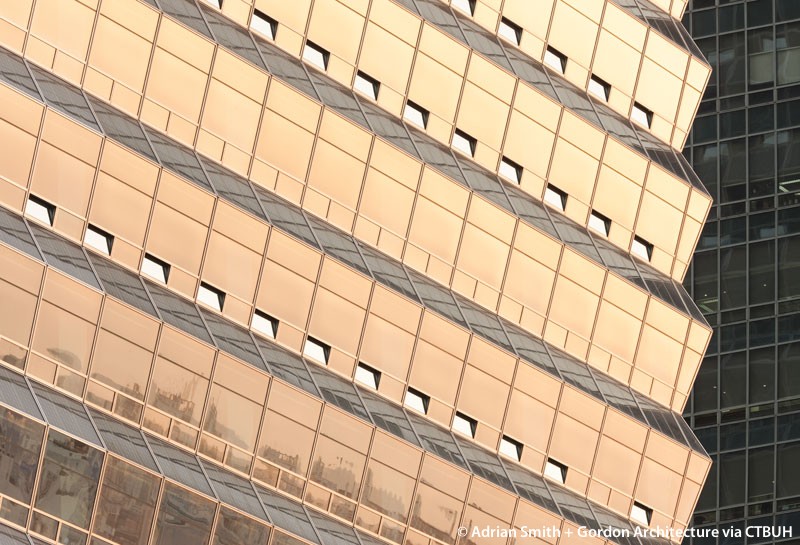
FKI’s unique exterior wall system combines maximum access to views, energy efficiency strategies and energy generation technologies. By angling the spandrel panels 30 degrees toward the sun, the amount of energy collected by the photovoltaic panels is maximized. Below the spandrel panels, the vision panels are angled 15 degrees toward the ground, minimizing the amount of direct sun radiation and glare.
The use of building integrated photovoltaic panels (BIPV) was seen as an architecturally appealing way to meet a strict zoning requirement that 5 percent of the building’s energy be created onsite, while the optimization of the panels became a driving factor in developing the architectural expression. The local electric utility company (KEPCO) provided a favorable 5-to-1 buy-back rate for onsite green-energy generation. The payback for the BIPV panels, which would have typically been 30-35 years, was reduced to about seven years, due to these incentives.
As part of the initial design process, an Ecotech model was used to determine the optimal areas for BIPV on an orthogonal building, given the surrounding buildings which partially shade the site. It was determined that BIPV would be best used on the southeast and southwest faces, above Level 14. Not all sides of the building are currently suitable for BIPV; therefore, it was important to design panels that were interchangeable with insulated spandrel panels for maximum flexibility, without a significant change in the symmetry of building expression. The design also allows for the panels to be replaced, as new technology that can take advantage of indirect light becomes available.
The result is a unique folded exterior texture that is both purposeful and visually distinctive. Benefits include a reduction of glare and heat gains from direct sunlight, while maintaining a high level of indirect light. Through most of the day, the building is able to use the geometry of the exterior wall to self-shade the perimeter spaces that would normally be inundated with direct sunlight.
FKI features an expansive rooftop atrium garden that also has custom photovoltaic panels. As with the exterior wall panels, the ideal angle of the panel placement on the roof was studied in detail. Within the limited area of FKI’s roof, it was determined that a 10-degree angle allowed for more panels to be installed closer together, minimizing the effect of the panels casting shadows on each other and ultimately producing more solar energy for the building.
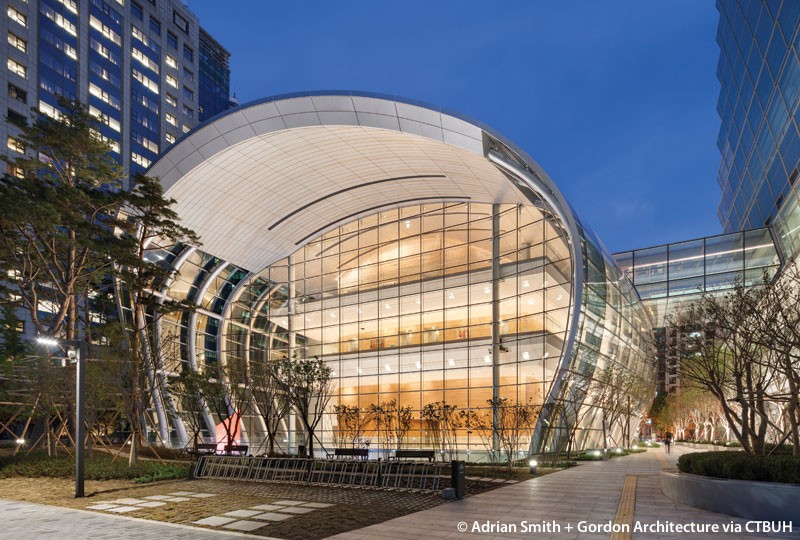
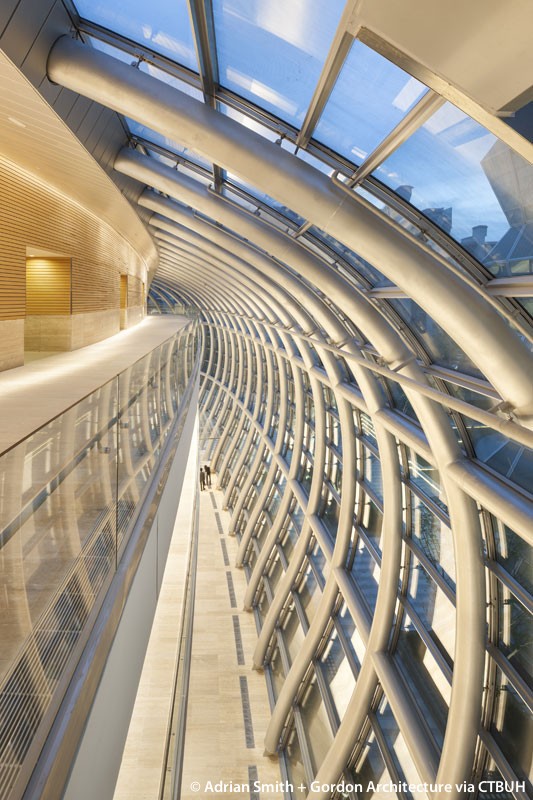
The sculptural podium piece’s amenities, available for public use, include a banquet hall, a central restaurant and a conference center. Site orientation was altered during the course of design, sliding the tower to the west. This opened up more site frontage and allowed the podium to be closer to the street, giving it a presence it would not have had if located behind the tower, and allows more space for outdoor public landscaped courtyards.
CVU Awards & Distinctions
Best Tall Building, by Region, Asia & Australasia 2014 Award of Excellence
2014 CVU Awards
Learn more about the Council on Vertical Urbanism
Discover how vertical living is shaping the next generation of urban environments. Explore insights, research, and global leadership in vertical urban development