




Height rank
Burj Khalifa
Dubai


som-nick-merrick-hedrich-blessing2010.jpg)
som-nick-merrick-hedrich-blessing2010.jpg)
som-nick-merrick-hedrich-blessing2010.jpg)


som-nick-merrick-hedrich-blessing2010.jpg)
som-nick-merrick-hedrich-blessing2010.jpg)


som-nick-merrick-hedrich-blessing2010.jpg)
som-nick-merrick-hedrich-blessing2010.jpg)
som-nick-merrick-hedrich-blessing2010.jpg)








som-nick-merrick-hedrich-blessing2010.jpg)
geoeyesatellite.jpg)



- CVU Drawing
- Facts
-
Metrics
You must be a CVU Member to view this resource.
- Structure
To Tip:
Height is measured from the level of the lowest, significant, open-air, pedestrian entrance to the highest point of the building, irrespective of material or function of the highest element (i.e., including antennae, flagpoles, signage and other functional-technical equipment).Architectural:
Height is measured from the level of the lowest, significant, open-air, pedestrian entrance to the architectural top of the building, including spires, but not including antennae, signage, flag poles or other functional-technical equipment. This measurement is the most widely utilized and is employed to define the Council on Vertical Urbanism (CVU) rankings of the "World's Tallest Buildings."Occupied:
Height is measured from the level of the lowest, significant, open-air, pedestrian entrance to the highest occupied floor within the building.
Above Ground
The number of floors above ground should include the ground floor level and be the number of main floors above ground, including any significant mezzanine floors and major mechanical plant floors. Mechanical mezzanines should not be included if they have a significantly smaller floor area than the major floors below. Similarly, mechanical penthouses or plant rooms protruding above the general roof area should not be counted. Note: CVU floor counts may differ from published accounts, as it is common in some regions of the world for certain floor levels not to be included (e.g., the level 4, 14, 24, etc. in Hong Kong).Below Ground
The number of floors below ground should include all major floors located below the ground floor level.Official Name
Burj Khalifa
Other Names
Burj Dubai
Type
Building
Status
Completed
Completion
2010
Country
City
Address
Function
A mixed-use tall building contains two or more functions (or uses), where each of the functions occupy a significant proportion of the tower's total space. Support areas such as car parks and mechanical plant space do not constitute mixed-use functions. Functions are denoted on CVU "Tallest Building" lists in descending order, e.g., "hotel/office" indicates hotel function above office function.
Office / Residential / Hotel
Structural Material
Both the main vertical/lateral structural elements and the floor spanning systems are constructed from steel. Note that a building of steel construction with a floor system of concrete planks or concrete slab on top of steel beams is still considered an “all-steel” structure as the concrete elements are not acting as the primary structure.
All-Concrete
Both the main vertical/lateral structural elements and the floor spanning systems are constructed from concrete which has been cast in place and utilizes steel reinforcement bars and/or steel reinforced concrete which has been precast as individual components and assembled together on-site.
All-Timber
Both the main vertical/lateral structural elements and the floor spanning systems are constructed from timber. An all-timber structure may include the use of localized non-timber connections between timber elements. Note that a building of timber construction with a floor system of concrete planks or concrete slab on top of timber beams is still considered an “all-timber” structure as the concrete elements are not acting as the primary structure.
Mixed-Structure
Utilizes distinct systems (e.g. all-steel, all-concrete, all-timber), one on top of the other. For example, a Steel Over Concrete indicates an all-steel structural system located on top of an all-concrete structural system, with the opposite true of Concrete Over Steel.
Composite
A combination of materials (e.g. steel, concrete, timber) are used together in the main structural elements. Examples include buildings which utilize: steel columns with a floor system of reinforced concrete beams; a steel frame system with a concrete core; concrete-encased steel columns; concrete-filled steel tubes; etc. Where known, the CVU database breaks out the materials used within a composite building’s primary structural elements.
Steel Over Concrete
Official Website
Height
828 m / 2,717 ft
Floors Above Ground
163
Floors Below Ground
1
# of Apartments
900
# of Hotel Rooms
304
# of Parking Spaces
2957
# of Elevators
58
Top Elevator Speed
10 m/s
Tower GFA
309,473 m² / 3,331,140 ft²
Structural Details:
Bottom of Building
Top of Building
Rankings
-
By function
You must be a CVU Member to view this resource.
-
By material
You must be a CVU Member to view this resource.
Construction Schedule
Proposed
Construction Start
Completed
Owner/Developer
Architect
Usually involved in the front end design, with a "typical" condition being that of a leadership role through either Schematic Design or Design Development, and then a monitoring role through the CD and CA phases.
Structural Engineer
The Design Engineer is usually involved in the front end design, typically taking the leadership role in the Schematic Design and Design Development, and then a monitoring role through the CD and CA phases.
MEP Engineer
The Design Engineer is usually involved in the front end design, typically taking the leadership role in the Schematic Design and Design Development, and then a monitoring role through the CD and CA phases.
Project Manager
The CTBUH lists a project manager when a specific firm has been commissioned to oversee this aspect of a tall building’s design/construction. When the project management efforts are handled by the developer, main contract, or architect, this field will be omitted.
The CTBUH lists a project manager when a specific firm has been commissioned to oversee this aspect of a tall building’s design/construction. When the project management efforts are handled by the developer, main contract, or architect, this field will be omitted.
Other Consultant
Other Consultant refers to other organizations which provided significant consultation services for a building project (e.g. wind consultants, environmental consultants, fire and life safety consultants, etc).
Other Consultant refers to other organizations which provided significant consultation services for a building project (e.g. wind consultants, environmental consultants, fire and life safety consultants, etc).
These are firms that consult on the design of a building's façade. May often be referred to as "Cladding," "Envelope," "Exterior Wall," or "Curtain Wall" Consultant, however, for consistency CTBUH uses the term "Façade Consultant" exclusively.
Material Supplier
Material Supplier refers to organizations which supplied significant systems/materials for a building project (e.g. elevator suppliers, facade suppliers, etc).
Material Supplier refers to organizations which supplied significant systems/materials for a building project (e.g. elevator suppliers, facade suppliers, etc).
You must be a CVU Member to view this resource.
Owner/Developer
Architect
Usually involved in the front end design, with a "typical" condition being that of a leadership role through either Schematic Design or Design Development, and then a monitoring role through the CD and CA phases.
Usually takes on the balance of the architectural effort not executed by the "Design Architect," typically responsible for the construction documents, conforming to local codes, etc. May often be referred to as "Executive," "Associate," or "Local" Architect, however, for consistency CTBUH uses the term "Architect of Record" exclusively.
Hyder Consulting
Structural Engineer
The Design Engineer is usually involved in the front end design, typically taking the leadership role in the Schematic Design and Design Development, and then a monitoring role through the CD and CA phases.
The Engineer of Record takes the balance of the engineering effort not executed by the “Design Engineer,” typically responsible for construction documents, conforming to local codes, etc.
Hyder Consulting
MEP Engineer
The Design Engineer is usually involved in the front end design, typically taking the leadership role in the Schematic Design and Design Development, and then a monitoring role through the CD and CA phases.
The Engineer of Record takes the balance of the engineering effort not executed by the “Design Engineer,” typically responsible for construction documents, conforming to local codes, etc.
Hyder Consulting
Project Manager
The CTBUH lists a project manager when a specific firm has been commissioned to oversee this aspect of a tall building’s design/construction. When the project management efforts are handled by the developer, main contract, or architect, this field will be omitted.
The CTBUH lists a project manager when a specific firm has been commissioned to oversee this aspect of a tall building’s design/construction. When the project management efforts are handled by the developer, main contract, or architect, this field will be omitted.
Contractor
The main contractor is the supervisory contractor of all construction work on a project, management of sub-contractors and vendors, etc. May be referred to as "Construction Manager," however, for consistency CTBUH uses the term "Main Contractor" exclusively.
Samsung C&T Corporation; Arabtec; BESIX
Other Consultant
Other Consultant refers to other organizations which provided significant consultation services for a building project (e.g. wind consultants, environmental consultants, fire and life safety consultants, etc).
Other Consultant refers to other organizations which provided significant consultation services for a building project (e.g. wind consultants, environmental consultants, fire and life safety consultants, etc).
Marsh/PMK International, LLC
Crystal Fountains Inc.; WET
Jaume Plensa
CBM Engineers; Coalco
CTL Group; Opening Solutions, Inc.
These are firms that consult on the design of a building's façade. May often be referred to as "Cladding," "Envelope," "Exterior Wall," or "Curtain Wall" Consultant, however, for consistency CTBUH uses the term "Façade Consultant" exclusively.
Lerch Bates; ALT Limited
Lee Herzog Consulting
Trend Foodservice Design & Consulting
Hirsch Bedner Associates
CD+M Lighting Design Group, LLC; Speirs + Major; Fisher Marantz Stone
Walker Parking Consultants
Emrill Services LLC
Square Peg Design
Material Supplier
Material Supplier refers to organizations which supplied significant systems/materials for a building project (e.g. elevator suppliers, facade suppliers, etc).
Material Supplier refers to organizations which supplied significant systems/materials for a building project (e.g. elevator suppliers, facade suppliers, etc).
ABB Group
Waagner Biro; JORDAHL; HALFEN; Al Ghurair
Unimix
Al Abbar Group; Tractel Secalt S.A.; Far East Aluminum Works Co., Ltd.; CoxGomyl
Hilti AG
Dorma
B-K Lighting; Designed Architectural Lighting; ERCO GmbH; Lucent Lighting; Oldham Lighting Projects Ltd; Philips Lighting; Tectronics; Zonca International Srl
Jotun
Dow Corning Corporation
CVU Awards & Distinctions
Global Icon Award 2010 Winner
2010 CVU Awards
Best Tall Building, by Region, Middle East & Africa 2010 Winner
2010 CVU Awards
Innovation Award 2015 Award of Excellence
2015 CVU Awards
10 Year Award 2020 Winner
2020 CVU Awards
Global News

30 July 2020
CTBUH In The Media: The Future of Skyscrapers: A Mile High, Slimmer Than Ever and Made from Wood
History does not want for dizzying fantasies of tall buildings. From the Tower of Babel onwards, humanity has dreamed of ever-more wondrous skyscrapers, whether we...
About Burj Khalifa
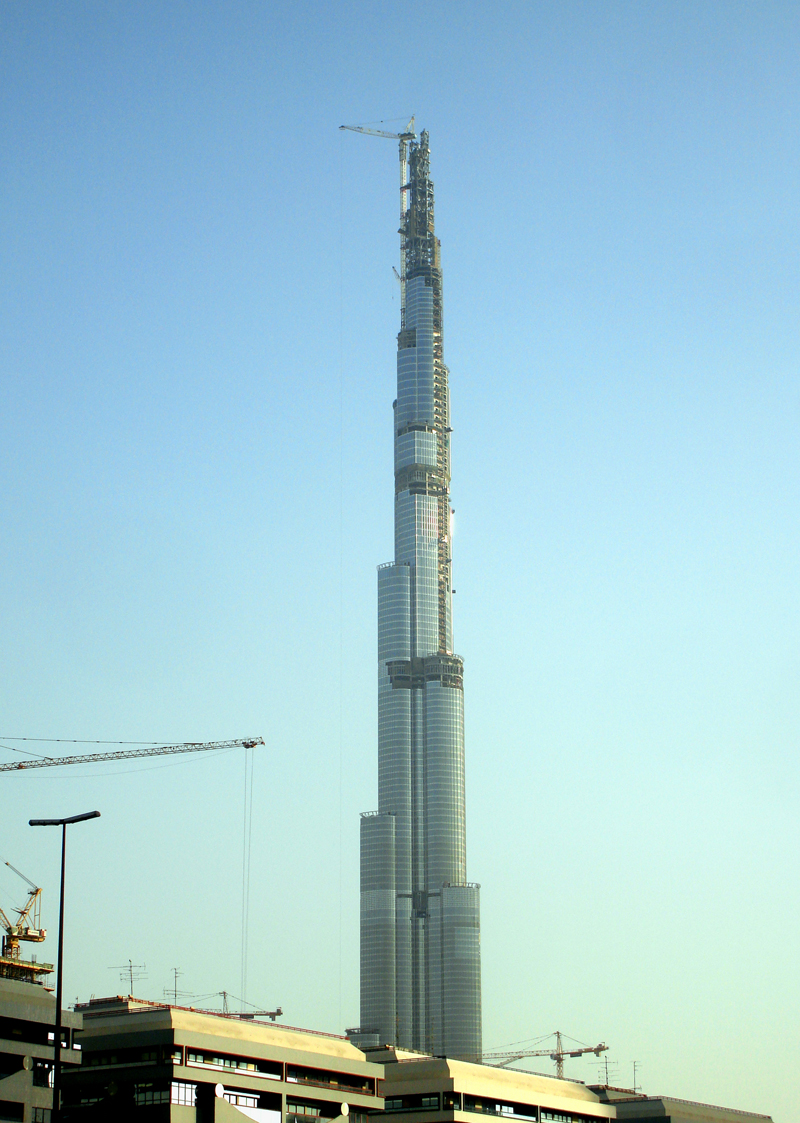
Burj Khalifa has redefined what is possible in the design and engineering of supertall buildings. By combining cutting-edge technologies and cultural influences, the building serves as a global icon that is both a model for future urban centers and speaks to the global movement towards compact, livable urban areas. The Tower and its surrounding neighborhood are more centralized than any other new development in Dubai. At the center of a new downtown neighborhood, Burj Khalifa’s mixed-use program focuses the area’s development density and provides direct connections to mass transit systems.
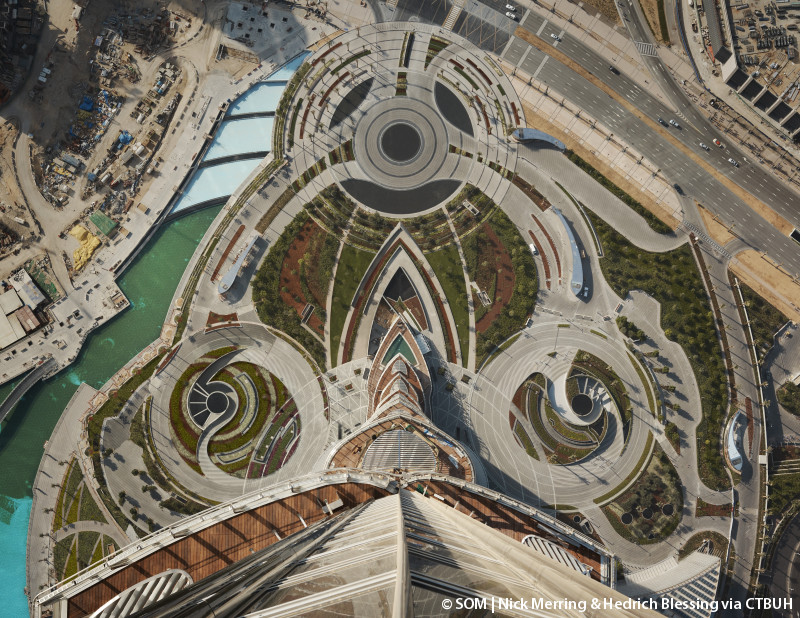
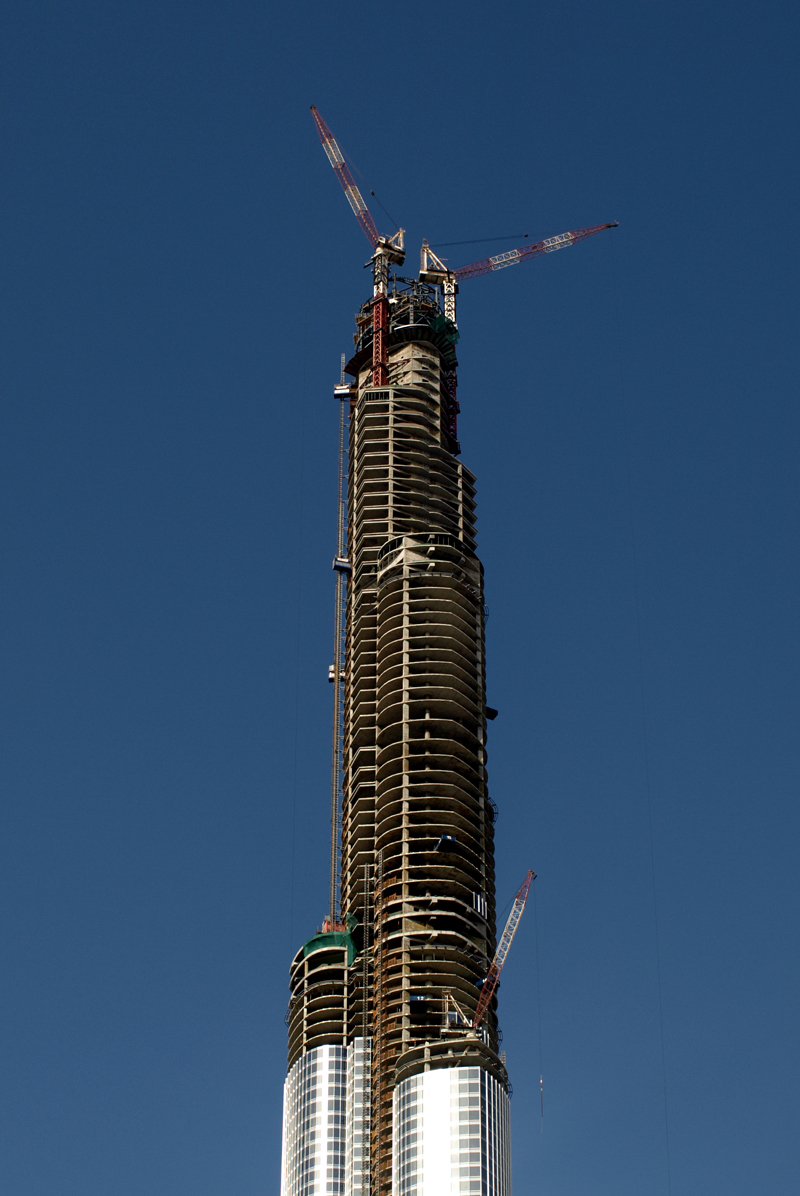
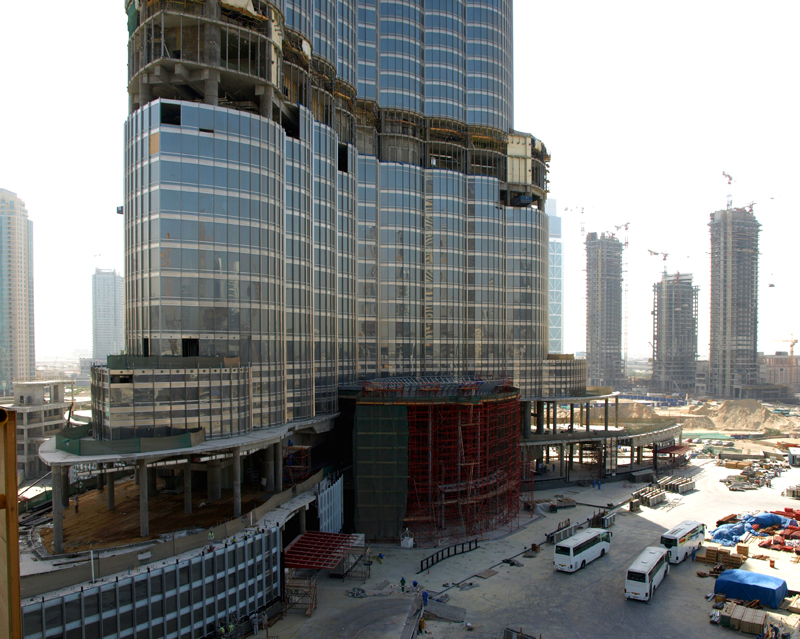
Burj Khalifa’s architecture has embodied references to Islamic architecture and yet reflects the modern global community it is designed to serve. The building’s Y-shaped plan provides the maximum amount of perimeter for windows in living spaces without developing internal unusable area. As the tapering tower rises, setbacks occur at the ends of each “wing” in an upward spiraling pattern that decreases the mass of the tower as the height increases. These setbacks were modeled in the wind tunnel to minimize wind forces. The design of the Tower was significantly influenced by its performance with respect to the wind, in both its shaping and orientation. The building went through many wind tunnel tests and design iterations to develop optimum performance.
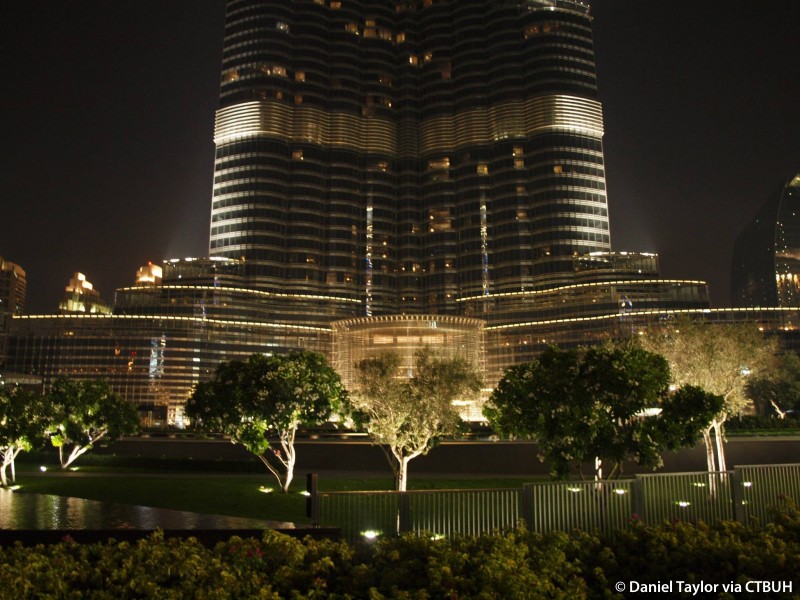
The exterior cladding, comprised of aluminum and textured stainless steel spandrel panels, was designed to withstand Dubai’s extreme temperatures during the summer months by using a low-E glass to provide enhanced thermal insulation. Vertical polished stainless steel fins were added to accentuate Burj Khalifa’s height and slenderness.
The unprecedented height of the Burj Khalifa required it to be an innovative building in many ways. Design techniques, building systems, and construction practices all required rethinking, and in many cases new applications, to create a practical and efficient building.
The structural system, termed a “buttressed core,” is designed to efficiently support a supertall building utilizing a strong central core, buttressed by its three wings. The vertical structure is tied together at the mechanical floors through outrigger walls in order to maximize the building’s stiffness. The result is an efficient system where all of the building’s vertical structure is used to support both gravity and lateral loads.
The Tower incorporates numerous enhancements to the fire and life safety systems, including “lifeboat” operation for elevators which allows for them to be used for controlled evacuation under certain situations, decreasing total evacuation time by 45% over stairs alone.
Due to its height, the building is able to utilize ventilation where cooler air temperatures, reduced air density, and reduced relative humidity at the top of the building allow for “sky-sourced” fresh air. When air is drawn in at the top of the building, it requires less energy for air conditioning, ventilation, and dehumidification. The building’s height also generates a substantial stack effect due to the thermal differences between the buildings’ interior and exterior, but Burj Khalifa was designed to passively control these forces, reducing the need for mechanical means of pressurization.
Burj Khalifa has one of the largest condensate recovery systems in the world. Collecting water from air conditioning condensate discharge prevents it from entering the wastewater stream and reduces the need for municipal potable water.
The tower’s management systems utilize smart lighting and mechanical controls which lower operational costs, allow for a more efficient use of building resources and services and better control of internal comfort conditions. Individual electric energy monitoring systems enable energy optimization of the tower’s systems over its lifetime.
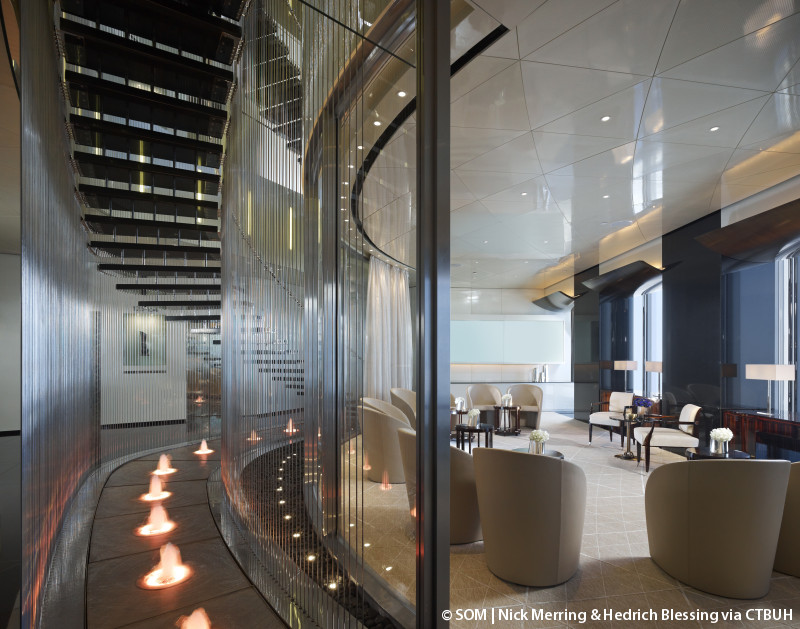
With over 185,800 sq m (2,000,000 sq ft) of interior space designed for Burj Khalifa, planning of the building’s interior space began at the earliest stages of its design focusing on three main goals—to recognize and acknowledge the building’s height, to integrate its structural and architectural rationale, and to appreciate the locale’s heritage, history and culture. The interiors of the uppermost floors were designed to reflect celestial influences. This is in contrast to the lower floors, which are inspired by natural elements.
An art program for the Tower was developed in which over 500 individual pieces of art were placed and specified throughout the Tower. The premier featured art piece resides in the tower’s residential lobby. This sculpture, completed by the internationally renowned artist Jaume Plensa, is entitled “World Voices” and is composed of 196 cymbals supported by stainless steel rods rising from two pools similar to reeds in a lake. The cymbals represent the 196 countries of the world and reflect that the Burj Khalifa was a result of a collaboration of many people from around the world.
CVU Awards & Distinctions
Global Icon Award 2010 Winner
2010 CVU Awards
Best Tall Building, by Region, Middle East & Africa 2010 Winner
2010 CVU Awards
Innovation Award 2015 Award of Excellence
2015 CVU Awards
10 Year Award 2020 Winner
2020 CVU Awards
Quick Facts
- The tallest building in the world. Preceded by Taipei 101.
- First building to hold the title of World's Tallest Freestanding Structure since the Empire State Buidling lost the title to the Ostankino Tower in 1967.
Learn more about the Council on Vertical Urbanism
Discover how vertical living is shaping the next generation of urban environments. Explore insights, research, and global leadership in vertical urban development