




33 Alfred Street
Sydney


ampltdarchives.jpg)
ampltdarchives.jpg)
ampltdarchives.jpg)
ampltdarchives.jpg)
ampltdarchives.jpg)
state__library__of__nsw.jpg)
ampltdarchives.jpg)
ampltdarchives.jpg)
ampltdarchives.jpg)
ampltdarchives.jpg)


- CVU Drawing
- Facts
-
Metrics
You must be a CVU Member to view this resource.
Architectural:
Height is measured from the level of the lowest, significant, open-air, pedestrian entrance to the architectural top of the building, including spires, but not including antennae, signage, flag poles or other functional-technical equipment. This measurement is the most widely utilized and is employed to define the Council on Vertical Urbanism (CVU) rankings of the "World's Tallest Buildings."Above Ground
The number of floors above ground should include the ground floor level and be the number of main floors above ground, including any significant mezzanine floors and major mechanical plant floors. Mechanical mezzanines should not be included if they have a significantly smaller floor area than the major floors below. Similarly, mechanical penthouses or plant rooms protruding above the general roof area should not be counted. Note: CVU floor counts may differ from published accounts, as it is common in some regions of the world for certain floor levels not to be included (e.g., the level 4, 14, 24, etc. in Hong Kong).Below Ground
The number of floors below ground should include all major floors located below the ground floor level.
Official Name
33 Alfred Street
Other Names
AMP Building, Australian Mutual Provident Society Head Office Building, Circular Quay
Type
Building
Status
Completed
Completion
1962
Country
City
Address
Function
A mixed-use tall building contains two or more functions (or uses), where each of the functions occupy a significant proportion of the tower's total space. Support areas such as car parks and mechanical plant space do not constitute mixed-use functions. Functions are denoted on CVU "Tallest Building" lists in descending order, e.g., "hotel/office" indicates hotel function above office function.
Office
Structural Material
Both the main vertical/lateral structural elements and the floor spanning systems are constructed from steel. Note that a building of steel construction with a floor system of concrete planks or concrete slab on top of steel beams is still considered an “all-steel” structure as the concrete elements are not acting as the primary structure.
All-Concrete
Both the main vertical/lateral structural elements and the floor spanning systems are constructed from concrete which has been cast in place and utilizes steel reinforcement bars and/or steel reinforced concrete which has been precast as individual components and assembled together on-site.
All-Timber
Both the main vertical/lateral structural elements and the floor spanning systems are constructed from timber. An all-timber structure may include the use of localized non-timber connections between timber elements. Note that a building of timber construction with a floor system of concrete planks or concrete slab on top of timber beams is still considered an “all-timber” structure as the concrete elements are not acting as the primary structure.
Mixed-Structure
Utilizes distinct systems (e.g. all-steel, all-concrete, all-timber), one on top of the other. For example, a Steel Over Concrete indicates an all-steel structural system located on top of an all-concrete structural system, with the opposite true of Concrete Over Steel.
Composite
A combination of materials (e.g. steel, concrete, timber) are used together in the main structural elements. Examples include buildings which utilize: steel columns with a floor system of reinforced concrete beams; a steel frame system with a concrete core; concrete-encased steel columns; concrete-filled steel tubes; etc. Where known, the CVU database breaks out the materials used within a composite building’s primary structural elements.
Composite
Height
115 m / 377 ft
Floors Above Ground
26
Floors Below Ground
2
# of Parking Spaces
83
# of Elevators
13
Top Elevator Speed
5.08 m/s
Tower GFA
49,839 m² / 536,463 ft²
Rankings
-
By function
You must be a CVU Member to view this resource.
-
By material
You must be a CVU Member to view this resource.
Construction Schedule
Proposed
Construction Start
Completed
Recladding
Retrofit Start
Retrofit End
Architect
Usually involved in the front end design, with a "typical" condition being that of a leadership role through either Schematic Design or Design Development, and then a monitoring role through the CD and CA phases.
Retrofit Companies Involved
Contractor
The main contractor is the supervisory contractor of all construction work on a project, management of sub-contractors and vendors, etc. May be referred to as "Construction Manager," however, for consistency CTBUH uses the term "Main Contractor" exclusively.
You must be a CVU Member to view this resource.
Owner
Australian Mutual Provident Society (AMP)
Developer
AMP Capital Investors
Architect
Usually involved in the front end design, with a "typical" condition being that of a leadership role through either Schematic Design or Design Development, and then a monitoring role through the CD and CA phases.
Structural Engineer
The Design Engineer is usually involved in the front end design, typically taking the leadership role in the Schematic Design and Design Development, and then a monitoring role through the CD and CA phases.
Rankine & Hill Consulting Engineers
MEP Engineer
The Design Engineer is usually involved in the front end design, typically taking the leadership role in the Schematic Design and Design Development, and then a monitoring role through the CD and CA phases.
John R. Wallis & Associates; Slocum & Fuller
Contractor
The main contractor is the supervisory contractor of all construction work on a project, management of sub-contractors and vendors, etc. May be referred to as "Construction Manager," however, for consistency CTBUH uses the term "Main Contractor" exclusively.
Concrete Constructions Pty Ltd
Retrofit Companies Involved
Contractor
The main contractor is the supervisory contractor of all construction work on a project, management of sub-contractors and vendors, etc. May be referred to as "Construction Manager," however, for consistency CTBUH uses the term "Main Contractor" exclusively.
About 33 Alfred Street
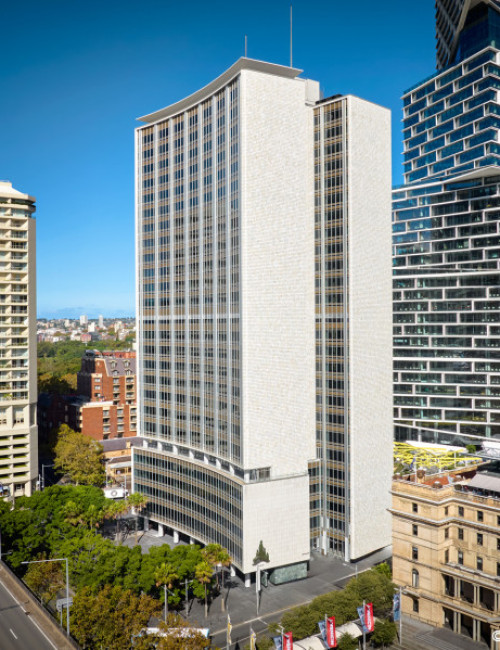
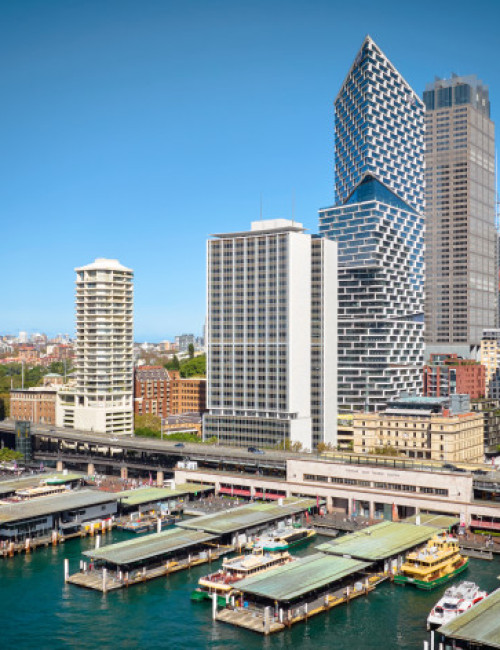
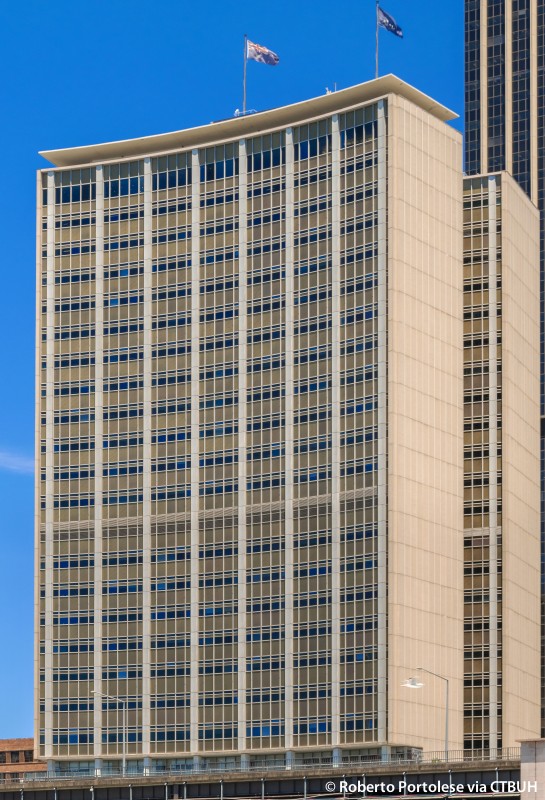
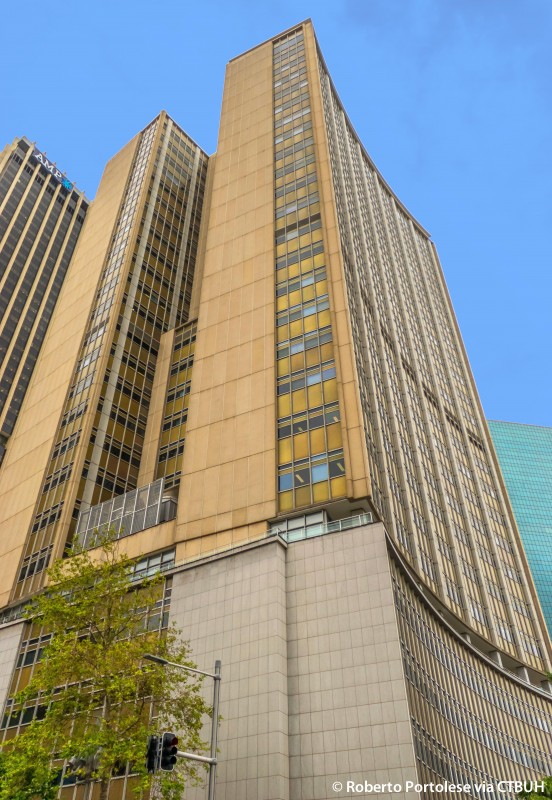
Often regarded as Australia’s first skyscraper, 33 Alfred Street was the first building to officially break the 1912 Sydney Height of Buildings Limit and became Australia’s tallest building upon completion in 1962. The concept design for AMP’s new headquarters began six years earlier as AMP started negotiations with the Sydney City Council and in 1957, submitted an application for permission to exceed the height limit of 150 feet to the New South Wales Chief Secretary, initiating 12 months of investigations by the state government and the Sydney City Council. After a revised application was submitted in 1959 for a tower set back on an urban plaza with the building footprint covering only 55 percent of the total site, permission was granted for construction to begin.
The prominent location of the building on Circular Quay made the approval process highly controversial over not only the height, but also the unconventional modern design of the tower featuring a curved façade. The building site also required the assembly of multiple properties, including a large five story wool store which had stood for 107 years before demolition commenced. After completion, 33 Alfred Street quickly became a notable landmark for the city’s waterfront gateway and offered the public an observation level commanding unobstructed views looking over the largely low-rise cityscape.
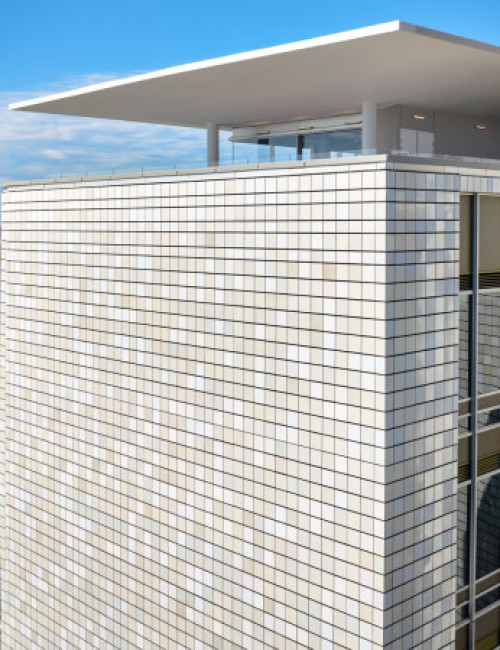
The revitalization of 33 Alfred Street included recalibrating all office floors for the workplace of the future; a re-activated public lobby and retail levels engaging with Scout Place and Goldsbrough Lane; new state-of-the-art End-of-Trip facilities; a reinvented sky terrace and complete facade renewal to improve views, comfort and energy use while preserving the landmark’s iconic character. The renewal has lifted the office space from B-grade to Premium and became 90% leased with tenants including four of the city’s top legal practices and an international investment bank at the conclusion of the repositioning project.
Learn more about the Council on Vertical Urbanism
Discover how vertical living is shaping the next generation of urban environments. Explore insights, research, and global leadership in vertical urban development