




Height rank
CCTV Headquarters
Beijing


oma-philippe__ruault.jpg)
butyrskii_igor.jpg)
oma-philippe__ruault.jpg)
oma-philippe__ruault.jpg)


butyrskii_igor.jpg)


tm.jpg)
tm.jpg)
tm.jpg)
- CVU Drawing
- Facts
-
Metrics
You must be a CVU Member to view this resource.
To Tip:
Height is measured from the level of the lowest, significant, open-air, pedestrian entrance to the highest point of the building, irrespective of material or function of the highest element (i.e., including antennae, flagpoles, signage and other functional-technical equipment).Architectural:
Height is measured from the level of the lowest, significant, open-air, pedestrian entrance to the architectural top of the building, including spires, but not including antennae, signage, flag poles or other functional-technical equipment. This measurement is the most widely utilized and is employed to define the Council on Vertical Urbanism (CVU) rankings of the "World's Tallest Buildings."Occupied:
Height is measured from the level of the lowest, significant, open-air, pedestrian entrance to the highest occupied floor within the building.Above Ground
The number of floors above ground should include the ground floor level and be the number of main floors above ground, including any significant mezzanine floors and major mechanical plant floors. Mechanical mezzanines should not be included if they have a significantly smaller floor area than the major floors below. Similarly, mechanical penthouses or plant rooms protruding above the general roof area should not be counted. Note: CVU floor counts may differ from published accounts, as it is common in some regions of the world for certain floor levels not to be included (e.g., the level 4, 14, 24, etc. in Hong Kong).Below Ground
The number of floors below ground should include all major floors located below the ground floor level.
Official Name
CCTV Headquarters
Other Names
China Central TV Headquarters
Type
Building
Status
Completed
Completion
2012
Country
City
Function
A mixed-use tall building contains two or more functions (or uses), where each of the functions occupy a significant proportion of the tower's total space. Support areas such as car parks and mechanical plant space do not constitute mixed-use functions. Functions are denoted on CVU "Tallest Building" lists in descending order, e.g., "hotel/office" indicates hotel function above office function.
Office
Structural Material
Both the main vertical/lateral structural elements and the floor spanning systems are constructed from steel. Note that a building of steel construction with a floor system of concrete planks or concrete slab on top of steel beams is still considered an “all-steel” structure as the concrete elements are not acting as the primary structure.
All-Concrete
Both the main vertical/lateral structural elements and the floor spanning systems are constructed from concrete which has been cast in place and utilizes steel reinforcement bars and/or steel reinforced concrete which has been precast as individual components and assembled together on-site.
All-Timber
Both the main vertical/lateral structural elements and the floor spanning systems are constructed from timber. An all-timber structure may include the use of localized non-timber connections between timber elements. Note that a building of timber construction with a floor system of concrete planks or concrete slab on top of timber beams is still considered an “all-timber” structure as the concrete elements are not acting as the primary structure.
Mixed-Structure
Utilizes distinct systems (e.g. all-steel, all-concrete, all-timber), one on top of the other. For example, a Steel Over Concrete indicates an all-steel structural system located on top of an all-concrete structural system, with the opposite true of Concrete Over Steel.
Composite
A combination of materials (e.g. steel, concrete, timber) are used together in the main structural elements. Examples include buildings which utilize: steel columns with a floor system of reinforced concrete beams; a steel frame system with a concrete core; concrete-encased steel columns; concrete-filled steel tubes; etc. Where known, the CVU database breaks out the materials used within a composite building’s primary structural elements.
Concrete-Steel Composite
Height
234 m / 768 ft
Floors Above Ground
54
Floors Below Ground
3
# of Parking Spaces
2702
# of Elevators
75
Top Elevator Speed
7 m/s
Tower GFA
316,000 m² / 3,401,396 ft²
Rankings
-
By function
You must be a CVU Member to view this resource.
-
By material
You must be a CVU Member to view this resource.
Construction Schedule
Proposed
Construction Start
Completed
Architect
Usually involved in the front end design, with a "typical" condition being that of a leadership role through either Schematic Design or Design Development, and then a monitoring role through the CD and CA phases.
Usually takes on the balance of the architectural effort not executed by the "Design Architect," typically responsible for the construction documents, conforming to local codes, etc. May often be referred to as "Executive," "Associate," or "Local" Architect, however, for consistency CTBUH uses the term "Architect of Record" exclusively.
Structural Engineer
The Design Engineer is usually involved in the front end design, typically taking the leadership role in the Schematic Design and Design Development, and then a monitoring role through the CD and CA phases.
The Engineer of Record takes the balance of the engineering effort not executed by the “Design Engineer,” typically responsible for construction documents, conforming to local codes, etc.
MEP Engineer
The Design Engineer is usually involved in the front end design, typically taking the leadership role in the Schematic Design and Design Development, and then a monitoring role through the CD and CA phases.
Other Consultant
Other Consultant refers to other organizations which provided significant consultation services for a building project (e.g. wind consultants, environmental consultants, fire and life safety consultants, etc).
Other Consultant refers to other organizations which provided significant consultation services for a building project (e.g. wind consultants, environmental consultants, fire and life safety consultants, etc).
You must be a CVU Member to view this resource.
Owner
China Central Television
Developer
General Office of CCTV New Site Construction & Development Program
Architect
Usually involved in the front end design, with a "typical" condition being that of a leadership role through either Schematic Design or Design Development, and then a monitoring role through the CD and CA phases.
Usually takes on the balance of the architectural effort not executed by the "Design Architect," typically responsible for the construction documents, conforming to local codes, etc. May often be referred to as "Executive," "Associate," or "Local" Architect, however, for consistency CTBUH uses the term "Architect of Record" exclusively.
Structural Engineer
The Design Engineer is usually involved in the front end design, typically taking the leadership role in the Schematic Design and Design Development, and then a monitoring role through the CD and CA phases.
The Engineer of Record takes the balance of the engineering effort not executed by the “Design Engineer,” typically responsible for construction documents, conforming to local codes, etc.
MEP Engineer
The Design Engineer is usually involved in the front end design, typically taking the leadership role in the Schematic Design and Design Development, and then a monitoring role through the CD and CA phases.
Contractor
The main contractor is the supervisory contractor of all construction work on a project, management of sub-contractors and vendors, etc. May be referred to as "Construction Manager," however, for consistency CTBUH uses the term "Main Contractor" exclusively.
China State Construction Engineering Corporation
Other Consultant
Other Consultant refers to other organizations which provided significant consultation services for a building project (e.g. wind consultants, environmental consultants, fire and life safety consultants, etc).
Other Consultant refers to other organizations which provided significant consultation services for a building project (e.g. wind consultants, environmental consultants, fire and life safety consultants, etc).
2x4
DHV Building and Industry; dUCKS scéno
These are firms that consult on the design of a building's façade. May often be referred to as "Cladding," "Envelope," "Exterior Wall," or "Curtain Wall" Consultant, however, for consistency CTBUH uses the term "Façade Consultant" exclusively.
Front Inc.
Romano Gatland
Inside Outside
Lighting Planners Associates
Fast Flow Systems Pte Ltd
Material Supplier
Material Supplier refers to organizations which supplied significant systems/materials for a building project (e.g. elevator suppliers, facade suppliers, etc).
Material Supplier refers to organizations which supplied significant systems/materials for a building project (e.g. elevator suppliers, facade suppliers, etc).
Guangdong JMA Aluminium Profile Factory (Group) Co., Ltd.
Armstrong World Industries
Jangho Group Co., Ltd.
AkzoNobel
China Construction Steel Structure Corporation
CVU Awards & Distinctions
Best Tall Building Worldwide 2013 Winner
2013 CVU Awards
Best Tall Building, by Region, Asia & Australasia 2013 Winner
2013 CVU Awards
About CCTV Headquarters
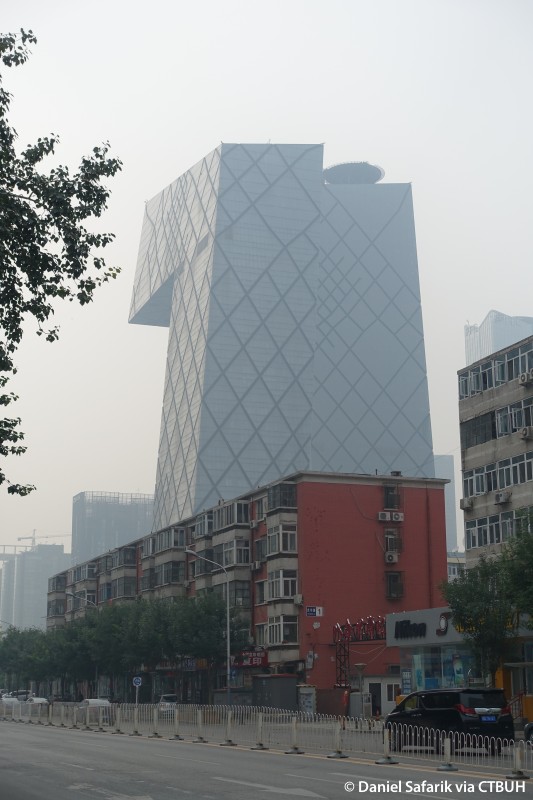
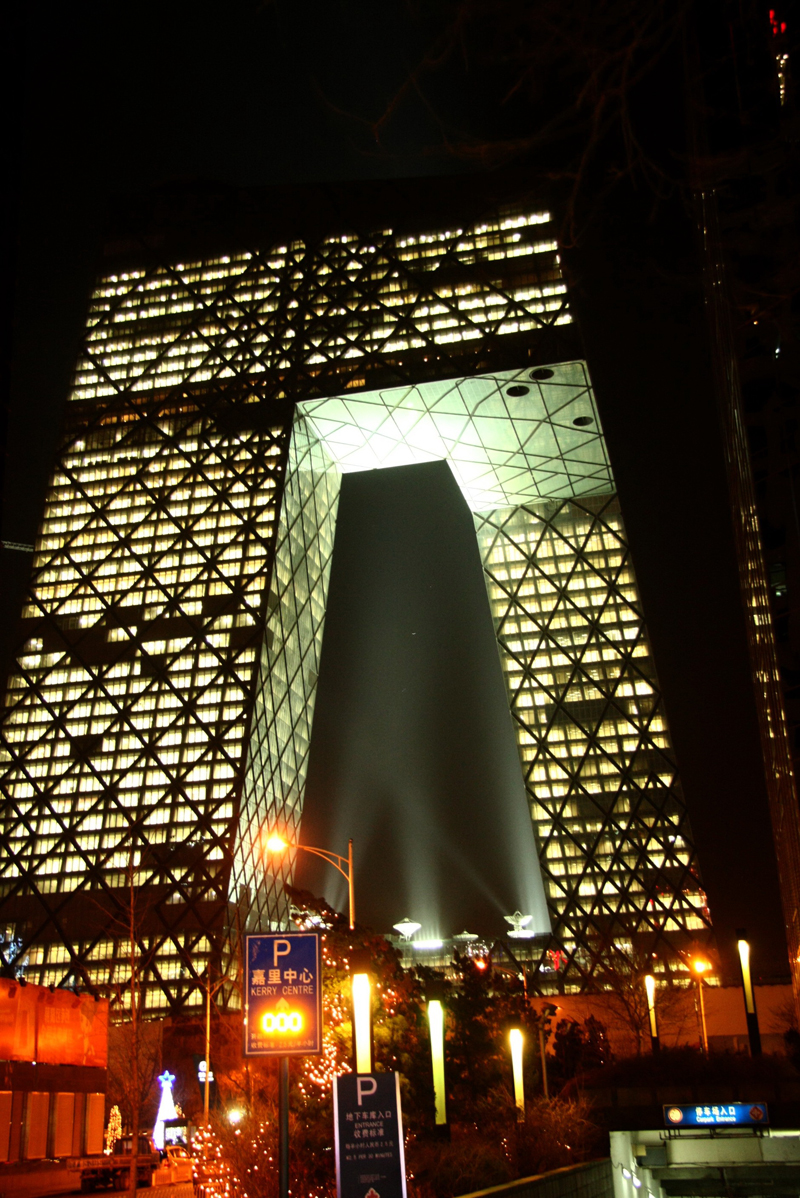
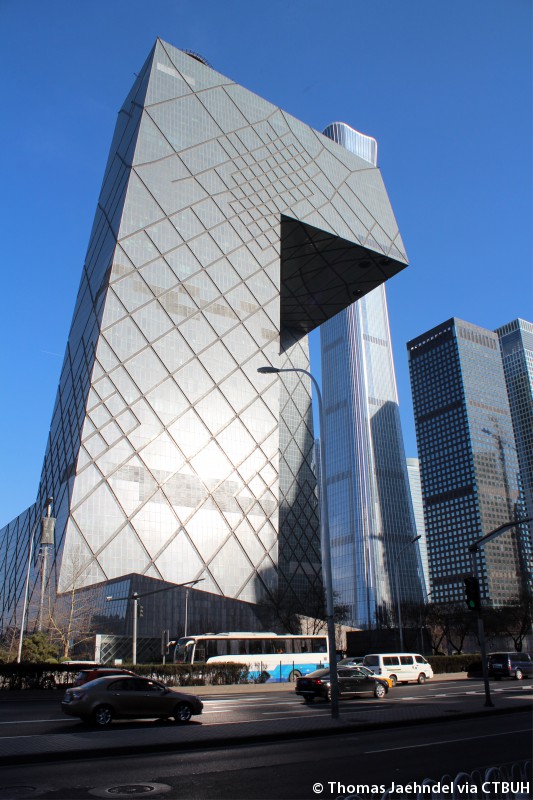
The CCTV headquarters is an unusual take on the skyscraper typology. Instead of competing in the race for ultimate height and style through a traditional two-dimensional tower soaring skyward, CCTV’s loop poses a truly three-dimensional experience, culminating in a 75-meter cantilever.
CCTV’s form facilitates the combination of the entire process of TV-making in a loop of interconnected activities. Two towers rise from a common production studio platform, the Plinth. Each tower has a different character: Tower 1 serves as editing area and offices, and the lower Tower 2 is dedicated to news broadcasting. They are joined by a cantilevering bridge for administration, the Overhang.
The main lobby, in Tower 1, is an atrium stretching three floors underground, and three floors up. It has a direct connection with Beijing’s subway network, and is the arrival and departure hub for the 10,000 workers inside CCTV headquarters. Connected to the lobby, 13 production studios (the largest is 2,000 square meters) perform the main function of the building: TV making.
The CCTV headquarters also facilitates an unprecedented degree of public access to the production of China’s media: a Public Loop takes visitors on a dedicated path through the building, revealing everyday studio work as well as the history of CCTV, and culminating at the edge of the cantilever, with spectacular views towards the CBD, the Forbidden City, and the rest of Beijing.
A Media Park forms a landscape of public entertainment, outdoor filming areas and production studios as an extension of the central green axis of the CBD.
The innovative structure of the CCTV Headquarters is the result of long-term collaboration between European and Chinese architects and engineers to achieve new possibilities for the high-rise. Early on, the team determined that the only way to deliver the desired architectural form was to engage the entire facade structure, creating in essence an external continuous tube system. The tube, which resists all of the lateral forces on the building and also carries much of the gravity force, is ideally suited to deal with the nature and intensity of permanent and temporary loading on the building.
The engineering forces at work are thus rendered visible on the façade: a web of triangulated steel tubes – diagrids – which, instead of forming a regular pattern of diamonds, become dense in areas of greater stress and looser and more open in areas requiring less support. The façade itself becomes a visual manifestation of the building's structure.
A versatile, efficient structure that bridges in bending and torsion between the Towers to create the continuous form of the Overhang section, the diagrid provides enough strength and stiffness in the Towers to carry loads to the ground. The structural system stiffens the podium and tower bases to favorably distribute loads to the foundation. It enables performance to be optimized, through adjustment of the bracing pattern, to satisfy contrasting demands of stiffness and flexibility.
The diagrid provides maximum flexibility for the bespoke planning of the interiors, since bracing is not needed within the floorplates. This allows large studio spaces to be laid out within the towers. It has enabled the Overhang section to be constructed without the need for temporary propping, since the braced skin provided stability as the steelwork was cantilevered out from the towers. This type of structure has a high degree of inherent robustness and redundancy, due to the potential for adopting alternative load paths in the unlikely event a key element’s removal.
The self-supporting hybrid facade structure features high performance glass panels with a sun shading of 70 percent open ceramic frit, creating the soft silver-grey color that gives the building a surprisingly subtle presence in the Beijing skyline.
CVU Awards & Distinctions
Best Tall Building Worldwide 2013 Winner
2013 CVU Awards
Best Tall Building, by Region, Asia & Australasia 2013 Winner
2013 CVU Awards
Learn more about the Council on Vertical Urbanism
Discover how vertical living is shaping the next generation of urban environments. Explore insights, research, and global leadership in vertical urban development